

The Labyrinth: A Sacred Pathway of Magic, Mystery, and Inner Transformation
There are symbols that whisper rather than speak, symbols that rise across continents and centuries without losing their power. Among them, the labyrinth stands alone — a single winding path, ancient as stone, mysterious as shadow, and spiritual as breath itself. It is not merely a pattern carved into earth or rock. It is a journey, a teaching, an initiation.
Long before modern spirituality emerged, labyrinths appeared in sacred sites across the world. They marked entrances to temples, lined the floors of ancient sanctuaries, spiraled into burial mounds, and were etched into the walls of caves lit only by flickering flame. Wherever humans sought the divine, the labyrinth emerged.
Its presence in so many cultures is not coincidence. It is archetype — a sacred geometry that mirrors the inner world. The labyrinth is the pathway into the self, the descent into mystery, the return transformed.
To walk a labyrinth is to step into a spiritual journey older than recorded language, a ritual that connects the seeker to magic, intuition, and the living pulse of the sacred.
The Ancient Origins of the Labyrinth
The earliest labyrinths predate written myth. Some of the oldest appear on stones in Neolithic Europe, drawn as spirals, coils, or single winding paths. They are believed to have served as ritual symbols tied to the cycles of life, death, and rebirth. In many sites, labyrinths appear near burial mounds or womb-like chambers deep within the earth — suggesting they represented the passageway between worlds.
Across the Mediterranean, the labyrinth took on a more formal structure. The most famous example is the Cretan labyrinth associated with Ariadne and the ancient rites of initiation. Yet even this myth, when viewed beneath its surface, speaks not of monsters and heroes but of descent, guidance, and transformation — the core themes of labyrinth magic.
In northern lands, labyrinths were carved near the sea and used in ritual navigation ceremonies, believed to guide spirits, protect travelers, or invite divine insight. Some were walked before fishing voyages or harvest rituals, each footstep becoming a prayer.
Despite their geographic distance, these labyrinths share unmistakable similarities: the single path, the inward spiral, the promise that the one who enters will not be the same upon returning.
The Labyrinth as a Spiritual Journey
Unlike a maze, a labyrinth has no tricks, no dead ends, no attempts to confuse. It does not ask the seeker to choose a path. It offers one path — the inner path — and invites the practitioner to walk it with intention.
This makes the labyrinth a powerful spiritual tool.
Walking a labyrinth is a ritual in itself. Each step becomes a release, a letting-go of the outside world. As the path winds inward, the mind begins to quiet. Breath deepens. The senses heighten. The body synchronizes with the slow, deliberate rhythm of the sacred.
At the center, the practitioner encounters a moment of stillness — a symbolic threshold. Some describe it as meeting the inner self. Others describe it as touching divine presence, clarity, or insight.
The journey outward is a rebirth. What was discovered at the center echoes outward into the world, carried within the renewed spirit of the walker.
This threefold movement — release, receive, return — mirrors ancient spiritual rites across cultures.
It is initiation.
It is magic.
It is transformation.
Labyrinths and the Sacred Feminine
Although labyrinths belong to all humankind, they have a long-standing connection to goddess traditions and feminine mystery paths.
In ancient Greece, the labyrinth was tied to Ariadne, a divine or semi-divine figure who offered guidance through darkness. Before she became entangled in heroic myths, Ariadne likely represented an older goddess of the moon, intuition, and initiatory rites. Her thread — the symbol that leads one safely through the labyrinth — represents wisdom, intuition, and the quiet voice that guides from within.
In pre-Greek and Neolithic cultures, labyrinths appear in contexts associated with the Great Mother, fertility rites, and womb symbolism. The spiral pattern recalls the turning of the seasons, the cycles of creation, and the inward journey into sacred depths.
The labyrinth is not feminine in a gendered sense — it is aligned with the feminine archetype, which represents intuition, descent, mystery, shadow, gestation, and rebirth. It mirrors the inward spiral of meditation, the cyclical motions of nature, and the hidden transformations that occur within.
For this reason, modern goddess traditions often use labyrinths for ceremonies of awakening, healing, initiation, and spiritual renewal.
Labyrinths in Magic and Ritual

Magical practitioners across traditions use labyrinths as energetic and symbolic tools. Whether drawn on paper, traced with the finger, constructed from stones, or walked in full physical form, labyrinths carry potent layers of meaning.
They are used for:
Inner work:
The winding path mimics the descent into self, making it ideal for shadow work, emotional healing, and introspective rituals.
Manifestation:
As the practitioner walks inward, they release what no longer serves. At the center, intention is planted like a seed. The outward journey becomes the activation.
Protection:
In folklore, labyrinths were placed near thresholds to confuse harmful spirits or to symbolically “trap” negative energies.
Cleansing:
A labyrinth walk can clear stagnant emotions and restore energetic balance.
Vision work:
The rhythmic movement induces a meditative state that opens intuitive channels.
Initiation:
Many spiritual groups use labyrinths for rites of passage — honoring beginnings, endings, and thresholds.
To walk a labyrinth is to engage with magic through the body. Each turn changes perspective, each step shifts awareness. It is embodied spellwork, grounded and sacred.
The Labyrinth as Sacred Geometry
The power of the labyrinth lies not only in its historical use but in its geometry. The single, spiraling path reflects patterns found in nature: the coil of a seashell, the arrangement of galaxies, the unfolding of a fern, the cycles of the moon.
These patterns are not merely aesthetic. They are archetypal frequencies — symbols that resonate with the subconscious and activate intuitive understanding. When one walks a labyrinth, the mind responds to this ancient geometry. It recognizes something familiar, something encoded deep within human memory.
Sacred geometry is the language of creation. The labyrinth is one of its oldest dialects.
Labyrinths as Thresholds Between Worlds
In many ancient cultures, labyrinths were placed at liminal spaces — boundaries between realms. They were carved at cave entrances, built near the sea, or embedded in temple floors. This placement was not random.
The labyrinth is a threshold symbol. It represents crossing from the ordinary into the extraordinary, from the mundane into the sacred, from surface consciousness into deeper awareness.
To step into a labyrinth is to step into a different layer of reality.
This makes labyrinths powerful tools for:
- spiritual transitions
- healing journeys
- grief rituals
- rites of passage
- preparing for major life changes
The practitioner enters carrying one self and returns carrying another.
How to Walk a Labyrinth as a Spiritual Practice
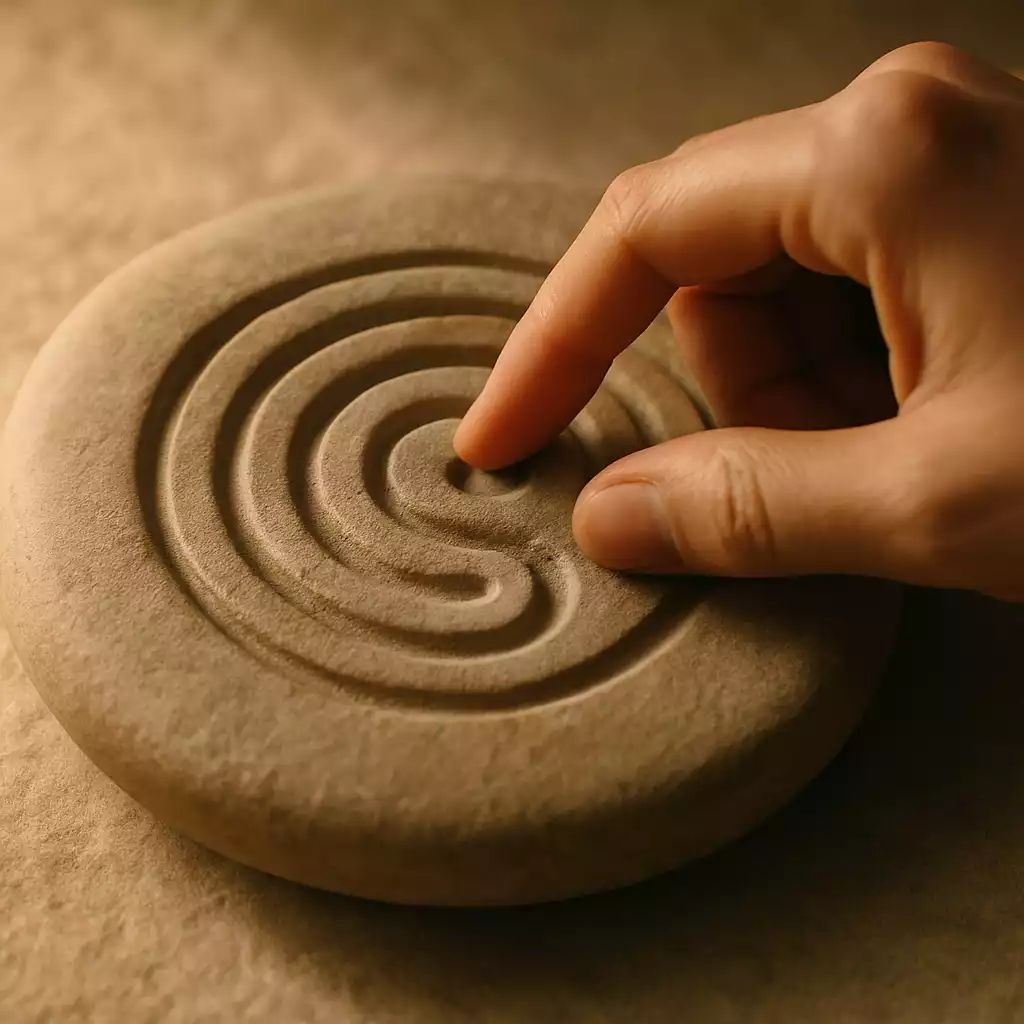
Although labyrinths are ancient, the practice remains accessible and simple.
Begin at the entrance.
Pause.
Set an intention — release, clarity, healing, connection, or simply presence.
As you walk inward, let each step soften the mind. The winding path will naturally create a meditative rhythm. If emotions arise, allow them. If insights come, observe them. If nothing comes, trust that the journey is unfolding beneath the surface.
At the center, pause again. This is the place of receiving.
Some kneel.
Some breathe deeply.
Some visualize light, insight, or transformation.
There is no right way to stand in the center — only the way that feels genuine.
The walk outward is a return. You carry your new understanding back into the world. The journey becomes a completed circle — inward, then outward, then onward.
Even if the labyrinth is traced with a finger on a small drawing, the symbolic journey remains powerful.
Labyrinths in Modern Spirituality
Today, labyrinths appear in gardens, retreat centers, parks, sanctuaries, and personal altars. Many practitioners create simple labyrinths with stones or flowers for rituals and seasonal ceremonies.
Their resurgence reflects a collective desire to slow down, return inward, and reconnect with the sacred.
Labyrinth walking is used in:
- spiritual retreats
- meditation workshops
- holistic healing
- grief recovery
- intuitive development
- rites of passage
- Earth-based ceremonies
- personal transformation work
The labyrinth remains relevant because the human spirit still seeks meaning, ritual, and stillness.
Why the Labyrinth Endures
The labyrinth endures because it is a mirror. It reflects the inner world, the cycles of life, and the natural patterns of the universe. It invites the practitioner to walk with intention, to explore hidden depths, and to return renewed.
It endures because the journey inward is always needed.
It endures because mystery is part of the human experience.
It endures because transformation is timeless.
In its silent, winding path, the labyrinth continues to offer guidance, healing, and magic to all who enter.
And in walking it, one discovers that the sacred path does not begin in ancient stone or distant myth — it begins within.
Last Updated on December 26, 2025 by Abigail Adams


Comments (2)
I’m the gate keeper of the 555 labyrinth portal in Bossier city boardwalk Louisiana. I walk it every night at 11:11
Thank you for this very interesting blog. I find labyrinths fascinating and am researching them. Could you explain the last section about the fact that you don’t meet the chakras in ROYGBIV order, and how that relates to the musical notes and numbers? I haven’t walked a labyrinth before and possibly that’s why I don’t understand the connection you’re describing. Best wishes.