
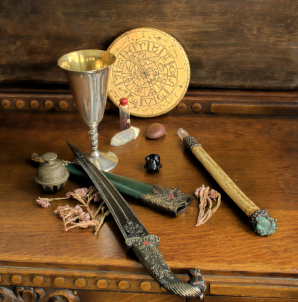
Altars of Light: A Sacred Guide for Beginners
The Altar as a Living Invitation to the Sacred
An altar is not just a table, a shelf, a tray, or a corner of your room.
It is a threshold — a place where the physical and the spiritual touch.
To create an altar is to say:
“I am ready to honor the sacred within me.”
“I welcome the Goddess into my life.”
“I choose to walk my path with intention.”
Whether you are a complete beginner or already on your path, an altar is one of the simplest, most powerful ways to bring magic into your daily life. It becomes:
- a sanctuary
- a reflection of your inner world
- a place of grounding
- a source of strength
- a place to heal, manifest, and reconnect
And above all — it is yours.
Your space.
Your energy.
Your story.
Your temple.
You do not need expensive tools.
You do not need rare herbs.
You do not need formal initiation or specialized training.
You only need intention, sincerity, and a willingness to create a small pocket of beauty where the sacred can breathe.
This article will guide you through the world of altars — what they are, the types you can create, how to build them, and how to use them — all in a positive, inspiring, beginner-friendly way.
What Is an Altar?
An altar is a dedicated space that holds your spiritual intention.
It can be:
- a corner of your desk
- a tray by your bedside
- a small shelf
- a window ledge
- a portable box
- a pouch you carry
- or a full, elaborate sacred room
The size does not matter.
The sincerity does.
An altar serves as a focal point where your heart, your energy, and the Goddess meet.
It can be used for:
- meditation
- prayer
- spellwork
- intention setting
- healing
- grounding
- seasonal celebrations
- honoring ancestors or deities
Think of it as a map of your inner world made visible.
Why Altars Matter — Especially for Beginners
Beginners often ask:
“Why do I need an altar?”
“Isn’t it just decoration?”
“Is it okay if it’s simple?”
The answer is:
Your altar is not decoration — it is activation.
Here’s why altars are so powerful:
1. They create energetic stability
An altar anchors your spiritual practice.
Even on chaotic days, it remains steady.
It becomes a place where your energy can settle and center.
2. They help beginners focus
New witches and Goddess seekers often struggle with:
- too much information
- uncertainty
- lack of confidence
- fear of “doing it wrong”
An altar simplifies everything.
It gives you a single place to return to.
3. They amplify intention
Where attention goes, energy flows.
Your altar collects your intentions and strengthens them over time.
4. They remind you that magic is real
Walking past your altar every day gently awakens your inner priestess.
You begin to feel the presence of the Goddess more clearly.
5. They nurture consistency
Even two minutes in front of your altar counts as spiritual practice.
Consistency builds confidence, intuition, and transformation.
6. They are sacred mirrors
Your altar reflects your inner journey:
- what you value
- what you seek
- what you are healing
- what you are becoming
It evolves as you evolve.
The Energy of an Altar
Every altar carries three energies:
1. Devotion
Your love, your sincerity, your intention.
2. Connection
Your relationship with the Goddess, the elements, ancestors, or personal spirit allies.
3. Identity
Your altar becomes a sacred extension of yourself — not who you were, but who you are becoming.
When you stand before your altar, you step into your spiritual identity.
You step into your empowerment.
You step into your becoming.
Types of Altars — Choosing What You Need
Beginners often think there is “one right way” to create an altar.
In truth, there are many, many ways — and you can use as few or as many as your heart desires.
Here are the most common types, explained gently and with love.
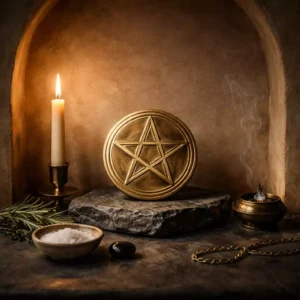
1. The Personal Altar (Your Main Altar)
This is your central sacred space — the place you go most often.
It might include:
- candles
- crystals
- flowers
- a goddess statue
- offerings
- a journal
- incense
This altar reflects your spiritual identity.
It is often a combination of:
- your energy
- your intentions
- your connection to the Divine
If you only create one altar, let this be the one.
2. The Goddess Altar
A goddess altar is dedicated to a specific deity or feminine archetype.
You may choose:
- Athena (wisdom, courage)
- Isis (magic, motherhood, healing)
- Oshun (love, sweetness, abundance)
- Hekate (magic, protection, crossroads)
- Brigid (creativity, fire, healing)
Or any goddess who calls to you.
A goddess altar might include:
- images
- symbols
- offerings
- candles in her colors
- flowers she loves
- items representing her energy
This altar becomes part of your relationship with her — a place where you speak, listen, and grow.
3. The Elemental Altar
This altar is dedicated to the Four Elements:
- Air (feathers, incense, paper)
- Fire (candles, red stones)
- Water (bowls, shells, moon water)
- Earth (plants, stones, salt)
Elemental altars help beginners:
- feel balanced
- connect with natural forces
- develop intuition
- feel grounded
If you’re unsure what type of altar to begin with, start here.
4. The Ancestral Altar
A gentle, powerful altar honoring those who came before you.
This altar may hold:
- photos
- heirlooms
- candles
- offerings of food or water
- letters
- written prayers
This altar connects you to protection, lineage, guidance, and healing.
5. The Healing Altar
For emotional, physical, or spiritual healing.
It may include:
- blue or white candles
- rose quartz
- herbs
- healing symbols
- written affirmations
- goddess statues of comfort (like Quan Yin or Yemaya)
This altar becomes a sanctuary — a place of softness, support, and renewal.
6. The Abundance or Manifestation Altar
Dedicated to prosperity, success, growth, and opportunity.
Include:
- green or gold candles
- coins
- cinnamon
- bay leaves
- citrine or pyrite
- written goals
- offerings to Lakshmi, Oshun, or Fortuna
This altar activates your intention to grow, prosper, and receive.
7. The Love Altar
This altar is not only for romance — it is for:
- self-love
- confidence
- healed relationships
- sacred sensuality
Use:
- roses
- pink candles
- rose quartz
- honey or sweets
- art that makes you feel beautiful and empowered
This altar strengthens your heart and your self-worth.
8. The Seasonal Altar (Wheel of the Year)
These altars shift with the seasons — spring, summer, autumn, winter — or with the pagan sabbats.
They help you connect with nature’s cycles and your own.
9. The Travel or Portable Altar
A small sacred kit you can take anywhere.
Include:
- tea light candle
- small crystal
- mini offering bowl
- tiny goddess image or symbol
- a protective charm
Perfect for vacations, hotel rooms, or times when privacy matters.
10. The Shadow Work Altar
This is for deep healing, transformation, and self-reflection.
Use:
- black candles
- obsidian
- journal entries
- symbols of release
- Hekate, Kali, Persephone
This altar helps you face what needs healing with courage and compassion.
How to Choose the Right Type of Altar
Beginners often feel overwhelmed by choices.
So here is a simple, empowering truth:
The altar you need will choose you.
Do any of the following feel true?
- You want comfort → Create a healing altar
- You want joy → Create a love altar
- You want stability → Create an elemental or earth altar
- You want guidance → Create a goddess altar
- You want transformation → Create a shadow altar
- You want prosperity → Create an abundance altar
- You want spiritual clarity → Create a personal altar
Follow your intuition — it is the Goddess speaking through you.
How to Build Your First Altar
This is the heart of the journey — and the most beautiful.
1. Choose the place
Pick a spot that feels calm, private, and respectful.
2. Cleanse the area
You can use:
- incense
- bells
- sound
- smoke
- visualization
- intention
Say softly:
“I cleanse this space with light and love.”
3. Place your anchor object
This is the heart of your altar.
It might be:
- a candle
- a goddess statue
- a crystal
- a bowl of water
- a symbolic item
4. Add supportive elements
Depending on the type of altar, add:
- crystals
- flowers
- symbols
- candles
- offerings
- personal objects
5. Set your intention
Say clearly, with love:
“This altar is a home for my magic, my healing, and my connection to the sacred.”
6. Activate the altar
Light a candle.
Say a prayer.
Sit in silence.
The moment you offer your attention, the altar becomes alive.
How to Use Your Altar — A Beginner’s Guide
Altars are not meant to sit untouched.
They come alive when you interact with them.
Here are ways to use your altar daily or weekly.
1. Light a candle
This is the simplest ritual of all.
A flame changes the energy of the room instantly.
2. Speak your intention
Say it softly.
Say it boldly.
Say it with emotion.
Your altar hears you.
3. Make small offerings
Offerings are not payment —
They are gratitude.
Examples:
- flowers
- water
- herbs
- sweets
- prayers
- written words
4. Meditate
Sit before your altar and breathe.
Even 2 minutes is enough.
5. Journal
Write what you feel, what you fear, what you desire.
6. Charge objects
Place crystals, jewelry, letters, or tools on your altar to bless them.
7. Clean and refresh
An altar loves attention.
Cleanliness helps energy flow.
How to Keep Your Altar Respectful
A beginner-friendly guide:
- Keep your altar clean.
- Replace wilted offerings.
- Never drop trash on or near it.
- Approach with sincere energy.
- Only place items you respect.
- If dedicated to a goddess, honor her story and traits.
Respect doesn’t mean perfection —
It means presence.
The Altar as a Mirror of Your Journey
Your altar will evolve as you do.
It may begin as a single candle.
Months later, it may become a full, glowing space of power.
Let it grow.
Let it shift.
Let it reflect your inner landscape.
When you are healing, it will look soft.
When you are manifesting, it will look vibrant.
When you are transforming, it may look intense.
When you are resting, it may look simple.
Your altar is a visual diary of your spiritual path.
A Simple Altar Ritual for Beginners
Here is a gentle ritual you can begin today.
1. Sit before your altar.
Feel the stillness.
2. Light a candle.
As the flame dances, imagine your inner flame rising.
3. Place your hand on your heart and say:
“This is my sacred space.
This is my becoming.
This is my connection to the Goddess and to myself.”
4. Take three deep breaths.
Inhale strength.
Exhale fear.
Inhale clarity.
Exhale doubt.
Inhale love.
Exhale anything that does not belong.
5. Whisper your intention.
Speak as if the universe is listening —
because it is.
6. Close the ritual with gratitude.
Say:
“Thank you for this moment of connection and light.”
Your altar will now hold and amplify your intention.
Your Life Is the True Altar
Altars are powerful.
Altars are beautiful.
Altars are transformative.
But the deepest truth is this:
Your life is the altar.
Your heart is the sacred flame.
Your body is the temple.
Your intentions are the offerings.
Your presence is the prayer.
Your physical altar is simply a reminder of the sacredness already within you.
And as you build your altar —
You build your power.
You build your confidence.
You build your relationship with the Goddess.
You build the life you desire.
Step forward with love.
Create your sacred space.
Let it hold you, guide you, inspire you, and empower you.
This is your beginning —
And your becoming.
Last Updated on December 26, 2025 by Abigail Adams


Leave a Reply