
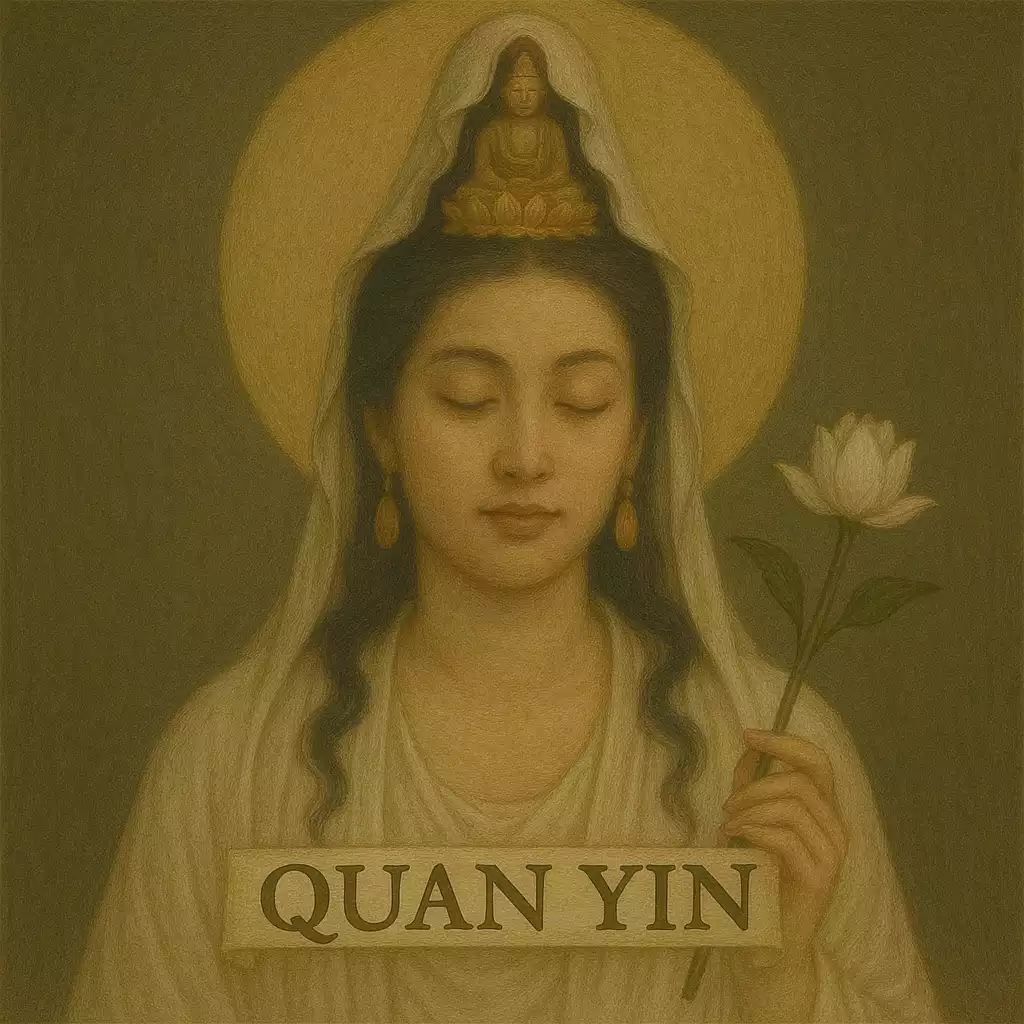
Goddess Quan Yin – Goddess of Wisdom and Mercy
Goddess Quan Yin — The Compassionate One, the Lotus-Born, and the Eternal Guardian of Mercy, Healing, and Grace
There are goddesses whose presence feels like flame — fierce, bold, all-consuming. And then there are those who arrive like a soft dawn: gentle, luminous, quiet yet immeasurably powerful. Quan Yin is one of the latter. She is not the goddess who overwhelms; she is the goddess who opens. She is not the goddess who commands; she is the goddess who listens. She is not the goddess of battle; she is the goddess who heals the wounds left by battles long past.
Quan Yin — also written Kwan Yin, Guan Yin, or Kuan Yin — is the revered East Asian Goddess of Compassion, Mercy, Healing, and Infinite Kindness. She is the one who hears the cries of the world. She is the one who comes when the heart is weary. She is the one who lifts women gently into their strength — not through force, but through tenderness.
Quan Yin is compassion in motion.
She is mercy embodied.
She is healing as a living force.
She does not demand worship; she invites trust.
She does not expect perfection; she embraces humanity.
She does not impose power; she awakens it from within.
For modern women, she is a sanctuary — a reminder that softness is not weakness, that compassion is not surrender, and that healing is not a destination but a sacred path.
This is Quan Yin:
the lotus-born mother of mercy,
the goddess who hears your heart,
the guide of healing, grace, and unconditional self-love.
Who Is Quan Yin?
Understanding the Goddess of Compassion
Quan Yin’s origins stretch across centuries, cultures, and spiritual traditions. She is venerated in Buddhism, Taoism, and folk religion throughout China, Japan, Korea, Vietnam, and beyond. She is a goddess and a bodhisattva — a being of enlightenment who chooses to remain close to humanity rather than ascend fully into transcendence.
Her name means:
- “She Who Hears the Cries of the World”
- “The One Who Observes the Sounds of Life”
- “She Who Perceives Suffering”
She is the divine listener, the heart-opener, the healer of sorrows.
Her Origin as Avalokiteśvara
Before becoming known as Quan Yin, she appears in early Buddhist texts as Avalokiteśvara, the male bodhisattva of compassion.
As Buddhism spread into China, the bodhisattva gradually transformed into a female form — a transformation guided by the hearts of the people who saw compassion as deeply connected to the sacred feminine.
By the Tang Dynasty, Avalokiteśvara had become Quan Yin — a compassionate goddess beloved for her kindness, healing presence, and willingness to answer prayers of the suffering.
Her Choice to Remain on Earth
Quan Yin once reached the very threshold of Nirvana — full enlightenment, freedom from the cycle of rebirth.
But when she heard the cries of suffering beings, she stopped.
She turned back.
She vowed:
“As long as even one soul suffers, I will stay.”
This vow is why she is worshipped not just as a goddess, but as an eternal mother — a being of pure compassion who refuses to abandon humanity.
Her Many Forms
Quan Yin appears in countless forms, each representing a different aspect of her power:
- The White-Robed Lady — purity, healing, peace
- The Thousand-Armed Goddess — ability to help all beings
- The Lotus-Born — spiritual awakening
- The Merciful Mother — unconditional love
- Protector of Women and Children — guardian of fertility, childbirth, and safety
- The Warrior of Compassion — fierce protector against harm
She is accessible to everyone — regardless of culture, gender, or path.
She is the goddess who says, “You are welcome exactly as you are.”
Quan Yin’s Teachings for Modern Women
To walk with Quan Yin is to learn how compassion becomes power.
She is not the goddess who shields you from life — she is the goddess who shows you how to rise through it.
She teaches that the heart is not fragile; it is resilient.
She teaches that softness can break barriers that force never could.
She teaches that healing is not weakness — it is transformation.
✨ 1. Compassion as Strength
Quan Yin teaches women that compassion is a superpower often dismissed in a world that values hardness. She shows that compassion:
- strengthens boundaries
- deepens intuition
- softens judgment
- empowers emotionally intelligent choices
Compassion does not ask you to ignore your own needs — it helps you understand them more deeply.
✨ 2. Self-Love as a Sacred Duty
Quan Yin does not simply heal; she teaches women to heal themselves.
Her presence supports those who have:
- internalized criticism
- carried guilt or shame
- struggled with self-worth
- sacrificed themselves for others
She whispers:
“Treat yourself the way you would treat the one you love most.”
✨ 3. Emotional Healing Without Apology
Quan Yin holds the wounded heart in gentle hands.
She helps women heal:
- grief
- heartbreak
- trauma
- abandonment
- internalized harshness
- self-neglect
Her energy reminds women that breaking down is part of becoming whole again.
✨ 4. Softness as Sacred Feminine Wisdom
Quan Yin is softness — but not fragility.
She is gentle — but not passive.
She is patient — but not powerless.
Her softness is deliberate.
Her gentleness is a choice rooted in strength.
Her compassion is the result of deep understanding.
Softness becomes a spiritual weapon in her presence — one that dissolves fear, anger, judgment, and self-doubt.
✨ 5. Boundaries Without Harshness
Quan Yin is misunderstood as endlessly forgiving, endlessly giving.
But she teaches boundaries through compassion:
- boundaries that protect
- boundaries that honor your heart
- boundaries that arise from love, not fear
Her lesson is simple:
“I choose peace, even if that requires distance.”
✨ 6. Healing Through Presence, Not Perfection
Quan Yin never asks you to be perfect.
She asks you to be present.
She invites women to:
- sit with their emotions
- breathe through their pain
- forgive themselves
- allow healing to unfold
Her grace transforms self-criticism into self-acceptance.
Correspondences of Goddess Quan Yin
Use these correspondences for devotional rituals, spells, offerings, and meditation practices.
Element:
Water (healing, purification)
Air (prayer, compassion)
Colors:
- White
- Pastel pink
- Soft green
- Pale blue
- Gold
Crystals:
- Rose quartz (self-love)
- Jade (prosperity & health)
- Moonstone (emotional balance)
- Selenite (purification)
- Amethyst (spiritual healing)
Herbs & Flowers:
- Lotus
- Jasmine
- Peony
- Lavender
- Sandalwood
- White tea
Symbols:
- Lotus flower
- Vase of healing water
- Willow branch
- White robes
- Compassionate gaze
- Thousand arms (aid to all)
Animals:
- White dragon
- Phoenix
- Doves
- Fish
- Cats
Offerings:
- Fresh flowers
- Clean water
- White candles
- Simple prayers
- Acts of compassion
- Soft music
- Incense (jasmine, sandalwood)
A Ritual to Invoke Quan Yin’s Healing and Compassion
This ritual opens the heart, softens emotional wounds, and invites healing into the body, mind, and spirit.
You Will Need:
- A white candle
- A bowl of clean water
- Rose quartz or jade
- Fresh flower petals (preferably lotus, but any white or pink flower works)
- A soft cloth or scarf
- A quiet space
1. Create a Sanctuary
Dim the lights.
Place the bowl of water before you.
Float the flower petals on its surface.
Place the rose quartz beside it.
Say softly:
“Quan Yin, Mother of Mercy and Healing,
Enter this space with your gentle grace.”
2. Light the White Candle
Let the flame represent compassion awakening within you.
Say:
“With this flame, I awaken love for myself and all beings.”
3. Purification Water Blessing
Dip your fingers into the bowl of water.
Touch your forehead, heart, and hands.
Say:
“May my mind be clear.
May my heart be healed.
May my actions be compassionate.”
4. Healing Invocation
Hold the rose quartz or jade to your heart.
Speak your deepest truth:
- “I release what hurts me.”
- “I forgive myself.”
- “I am ready to heal.”
- “I call compassion into my life.”
Allow emotions to rise without judgment.
5. The Lotus Meditation
Sit quietly with the candle.
Visualize a lotus blooming in your chest — soft, pink, luminous.
Feel its petals open as old pain dissolves.
Breathe deeply:
Inhale peace.
Exhale suffering.
6. Wrap Yourself in Softness
Drape the scarf or cloth over your shoulders.
This symbolizes Quan Yin’s loving embrace.
Say:
“I am held.
I am safe.
I am loved.”
7. Close the Ritual
Thank Quan Yin.
Blow out the candle.
Pour the water outside or into a plant as a blessing of renewal.
A Chant for Quan Yin — “Lotus Heart, Open in Me”
Quan Yin, gentle, wise and near,
Hold my heart and quiet my fear.
Lotus light and healing free—
Let compassion rise in me.
Repeat 3, 6, or 9 times.
Walking With Quan Yin — Becoming the Woman Who Heals With Grace
Quan Yin is not the goddess of protection through force — she is the goddess of protection through compassion. Her power is subtle but transformative. She guides women into a strength that is soft, fluid, intuitive, and grounded in love.
She teaches you:
✨ You do not need to harden to survive.
✨ You do not need to be perfect to be worthy.
✨ Your emotions are sacred messengers.
✨ Healing is not linear — it’s cyclical, like breath.
✨ Compassion begins with how you treat yourself.
Walking with Quan Yin means walking with gentleness — toward yourself, toward others, and toward your own destiny.
She asks you to become:
- softer in judgment
- stronger in boundaries
- kinder in self-talk
- deeper in awareness
- clearer in intention
- braver in healing
Quan Yin is the goddess who kneels beside every woman who has ever cried alone.
She is the whisper in moments of despair:
“You are not alone.”
She is the warmth inside the heart that says:
“You are worthy of love.”
And she is the guide who walks with you as you rise from pain into peace.
Quan Yin does not demand devotion — she responds to sincerity.
Her presence is simple, accessible, immediate.
All you must do is call her name.
Because she is, and forever will be:
The One Who Hears.
And through her, you remember this truth:
You are a woman of healing.
You are a woman of compassion.
You are a woman of grace.
You are Quan Yin’s daughter —
and you rise softly, beautifully, powerfully.
Last Updated on December 12, 2025 by Abigail Adams


Comment (1)
Thank you for beautiful story of Quan Yin
Very gentle and inspiring
Blessings Trisha