
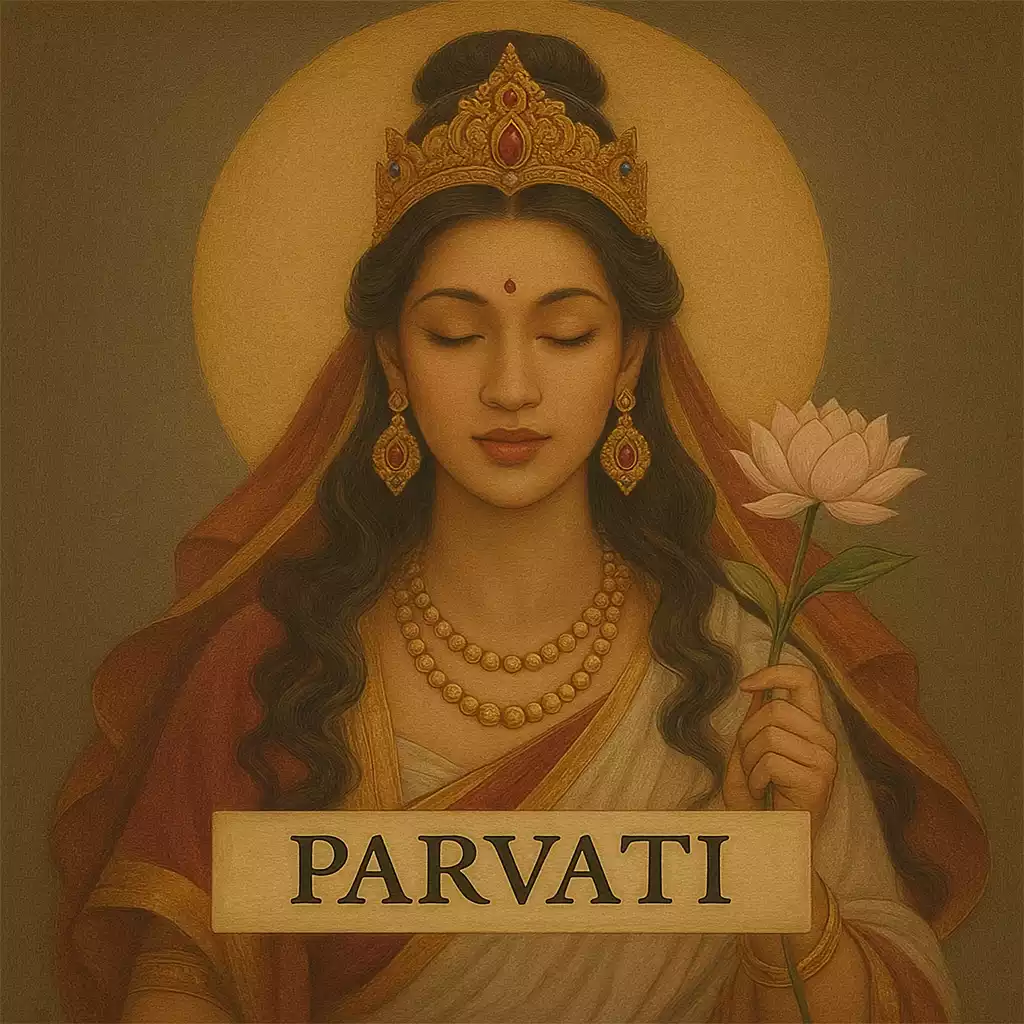
Goddess Parvati: Love, Strength, Devotion & Inner Power
Goddess Parvati — The Mountain’s Daughter, the Inner Flame of Devotion, and the Quiet Power That Moves the Universe
Some goddesses roar like storms.
Some ignite like lightning.
Some appear with fire, thunder, and fierce transformation.
Parvati is not that kind of goddess.
Her power arrives differently —
not in the chaos of a storm,
but in the stillness before dawn.
Parvati is the goddess of devotion, love, strength, inner fire, sacred purpose, balance, and self-mastery. She is the divine feminine presence who teaches that softness is not weakness and patience is not submission. She is the woman who climbs mountains for love, who performs austerities for spiritual truth, who builds her power quietly and steadily until the universe must bow.
She is the goddess who shows women how to transform through inner discipline rather than outer force — through self-belief, self-devotion, and unwavering clarity.
Parvati is strength wrapped in grace.
Power wrapped in patience.
Fire wrapped in calm.
She is the reminder that the quiet woman is not weak — she is gathering her strength.
Who Is Parvati?
A Guide for Readers Discovering Her for the First Time
If someone has never heard of Parvati, the simplest introduction is this:
Parvati is one of the most revered Hindu goddesses — the embodiment of love, devotion, spiritual determination, inner strength, harmony, and divine union.
She is the consort of Shiva, the great ascetic, and mother of Ganesha and Kartikeya. But she is not defined by them — she defines herself through her choices, her path, and her own spiritual power.
Parvati is the universal archetype of:
✨ The woman who transforms herself
✨ The woman who loves deeply without losing her identity
✨ The woman who is soft and fierce at the same time
✨ The woman who can shift between roles with grace
✨ The woman who chooses herself even when choosing love
She is:
- gentle and warrior-like
- nurturing and disciplined
- romantic and strategic
- loving yet fiercely independent
Parvati is not the goddess of passivity — she is the goddess of intentional becoming.
Origins of Parvati — Daughter of the Mountain
Parvati’s name means “daughter of the mountain.”
She is the child of Himavan, the Himalaya King, and Queen Mena.
Her birth is symbolic:
The mountain is powerful, immovable, steady, and unshakeable.
So is Parvati.
She is born not from chaos or cosmic storms, but from the earth’s oldest, most grounded force. Her presence is reliable, steady, nurturing, stable — like a mountain that watches over everything with ancient insight.
In Hindu tradition, Parvati is considered a form of Shakti — the divine feminine energy that empowers the universe. She is the benevolent, peaceful aspect of this cosmic force.
But Shakti is never one-dimensional.
Her power has layers, and Parvati holds all of them.
The Story of Parvati — Love, Strength, Devotion, and Self-Transformation
Parvati’s mythology is rich and beautiful, and one of the most empowering goddess stories ever told. Her journey contains elements of self-love, discipline, purpose, courage, and emotional intelligence.
Her most well-known story is the tale of her union with Shiva — a sacred, complex, deeply symbolic love that teaches what it means to love without losing yourself.
✨ Parvati Meets Shiva — The Eternal Flame
Parvati is born already devoted to Shiva — not in a passive way, but with a mysterious soul-knowing. She recognizes his spiritual depth, his ascetic wisdom, his cosmic stillness. Shiva, however, is a renunciant — detached from worldly desires, deep in meditation, uninterested in marriage or relationships.
Many women loved Shiva, but none could move him from his spiritual focus.
Parvati was different.
She did not attempt to seduce him.
She did not try to win his attention.
She did not beg for his love.
She transformed herself.
Through meditation, discipline, austerity, self-dedication, and unwavering devotion, she built her inner power until even the great Shiva could not ignore her.
This is Parvati’s first great lesson:
You do not chase what is meant for you —
you become powerful enough that it cannot resist your presence.
✨ Parvati’s Tapasya — The Path of Self-Mastery
Parvati’s greatest act is her tapasya — her period of intense spiritual practice.
She retreats into the forest.
She meditates for years.
She overcomes her fears.
She conquers her desires.
She purifies her body and mind.
She becomes whole within herself.
Her devotion is not to Shiva — it is first to herself.
Only after she becomes her fullest, most awakened form does Shiva awaken from his meditation and recognize her.
Their union is not one of dependence —
it is one of equality.
Shiva does not “choose” Parvati because she waited for him.
He chooses her because she transformed into her divine truth.
✨ Marriage of Equals
Parvati becomes Shiva’s equal — intellectually, emotionally, spiritually, and cosmically. They represent the sacred balance of masculine (Shiva) and feminine (Shakti) energy.
Without her, Shiva is pure consciousness without energy.
Without him, she is energy without direction.
Together, they create the universe.
✨ Parvati as Mother
Parvati is also the mother of Ganesha and Kartikeya. But even here, she maintains her sovereignty:
- She creates Ganesha herself, without Shiva, purely from her own power.
- She nurtures Kartikeya into a warrior.
- She balances motherhood with cosmic responsibility.
Her motherhood is not sacrifice — it is strength.
What Parvati Means for Modern Women
Parvati’s story is not just myth — it is a map for women seeking empowerment today.
Her energy teaches that:
✨ You can be soft and still powerful.
✨ You can love deeply and still be independent.
✨ You can pursue devotion without losing yourself.
✨ That discipline is a form of self-love.
✨ That becoming your best self brings your best partnerships.
✨ That quiet strength can move worlds.
Parvati’s medicine is subtle but profound.
Parvati Teaches Women to Become Their Best Selves Without Apology
Parvati does not wait to be chosen — she chooses herself first.
She becomes whole.
She becomes grounded.
She becomes spiritually aligned.
She becomes powerful through self-awareness.
She teaches:
“Work on your inner world, and your outer world will match it.”
Parvati Teaches Love Without Losing Identity
Her relationship with Shiva is not about submission.
It is about union.
She teaches women:
- do not shrink to be loved
- do not abandon your purpose for a partner
- do not silence your voice
- do not lose yourself in another
Love should elevate, not erase.
Parvati Teaches Disciplined Transformation
Her tapasya is a metaphor for:
- letting go of old habits
- healing emotional patterns
- stepping into purpose
- refining your energy
- becoming intentional
Transformation does not have to be chaotic —
it can be graceful, structured, and quiet.
Parvati Teaches Balance
She holds multiple roles:
- lover
- mother
- warrior
- priestess
- queen
- sage
- ascetic
- playful maiden
She embodies the multiplicity within women — showing that you do not need to choose between identities. You can be all of them.
Parvati Teaches Self-Worth
Her love for Shiva is not needy.
Her devotion is not desperation.
Her patience is not passivity.
She knows her value.
She knows her power.
She knows that the right partnership meets her equally.
Correspondences of Goddess Parvati
Element:
Earth (stability), Fire (inner discipline)
Colors:
Pink, red, gold, yellow, deep green
Crystals:
Rose quartz, garnet, citrine, moonstone, carnelian
Herbs & Scents:
Jasmine, sandalwood, rose, saffron, turmeric
Symbols:
Lotus, mountain, crescent moon, trident (trishula), mala beads
Animals:
Lion, cow, elephant
Offerings:
Flowers (especially roses and jasmine), milk, honey, sweet treats, incense, self-discipline, devotional practice
A Ritual to Invoke Parvati — Self-Devotion, Inner Strength & Soul-Level Alignment
This ritual is for women seeking clarity, groundedness, or transformation through intentional self-focus.
You Will Need:
- A pink or red candle
- A bowl of water
- A small mirror
- A flower (rose or jasmine)
- A journal or paper
1. Create the Sacred Space
Sit comfortably. Place the candle before you.
Hold the flower in your hands.
Say:
“Parvati, Mountain Daughter and Inner Flame,
Sit with me as I awaken my strength.”
2. Light the Candle — Igniting Inner Fire
As the flame rises, imagine your inner strength glowing brighter.
Say:
“Illuminate what I must see.
Strengthen what I must become.”
3. Water of Reflection
Dip your fingers into the water and touch the mirror.
This symbolizes emotional clarity and honest self-reflection.
Say:
“Help me see myself clearly.
Help me know my own worth.”
4. Write Your Intention for Transformation
In your journal or on the paper, write what you want to cultivate:
- confidence
- healing
- patience
- self-love
- purpose
- emotional balance
- spiritual discipline
Fold the paper and place the flower on top.
5. Parvati Invocation
Place your hand over your heart.
Say:
“Parvati,
Guide me toward my highest self.
Help me rise with grace.
Help me transform with intention.
Help me walk my path with devotion and strength.”
Feel the energy settle around you — gentle but unshakeable.
6. Close the Ritual
Blow out the candle slowly, sending your intention into the universe.
Place the flower somewhere special until it dries naturally.
A Chant for Parvati — “Strength in Softness, Fire in My Heart”
Parvati, wise and glowing bright,
Guide my steps and shape my light.
Soft in heart yet strong in will—
Help my spirit rise and fill.
Repeat 7, 9, or 12 times.
Walking With Parvati — Becoming the Woman Who Chooses Herself
Parvati does not demand immediate transformation.
She teaches transformation through patience, devotion, and self-respect.
She teaches women:
✨ You can be powerful without being loud.
✨ You can be soft without being weak.
✨ You can love without losing yourself.
✨ You can transform without chaos.
✨ You can rise without rushing.
✨ You can build your life with intention.
Her path is not about force.
Her path is about alignment.
She reminds you:
“Your inner world is sacred.
When you honor it, everything else aligns.”
Walking with Parvati means walking with:
- emotional strength
- inner peace
- purposeful transformation
- self-devotion
- spiritual clarity
- grounded confidence
You become the woman who does not chase —
she attracts.
You become the woman who does not beg —
she knows her value.
You become the woman who does not shrink —
she rises.
And Parvati whispers to you:
“Become.
Evolve.
Transform.
Your power is already within you.”
You are Parvati’s daughter —
steady as the mountain,
glowing as the flame,
soft as the blossom,
and stronger than you ever imagined.
Last Updated on December 12, 2025 by Abigail Adams




Leave a Reply