
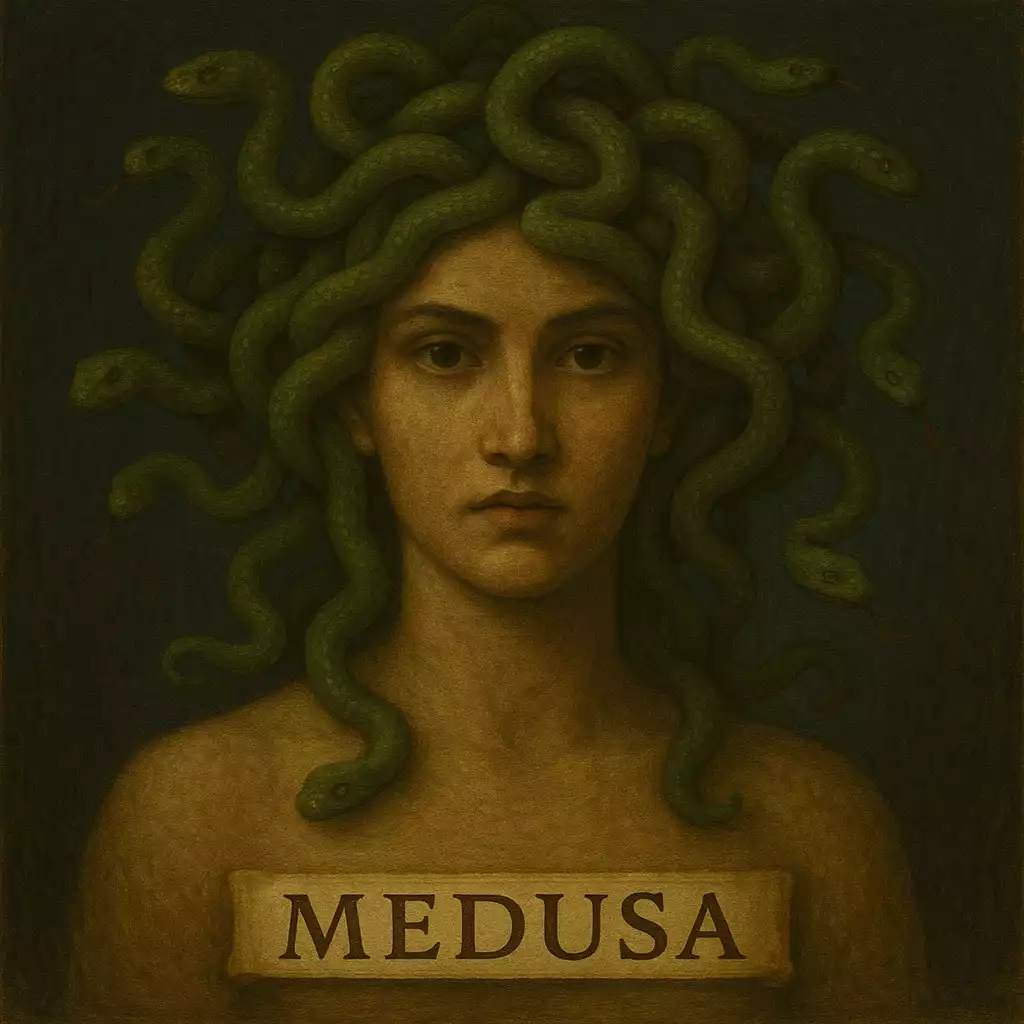
Medusa: The Serpent Crown, the Shattered Silence, and the Reclaimed Goddess
There are figures in mythology whose names were twisted, whose stories were stolen, whose power was buried beneath centuries of fear.
And yet, they rise.
Among them, none shines more fiercely than Medusa.
She has been called a monster, a warning, a terror, a thing to be slain. But beneath the layers of distortion lies one of the most profound symbols of feminine resilience ever recorded. Medusa is not merely a myth—she is a mirror. She is the story of what happens when a woman’s power is feared, violated, cursed, and finally reclaimed.
For a coven devoted to the Goddess, Medusa stands as a primal archetype:
the survivor, the avenger, the sacred guardian, the one who transforms her wounds into weaponry.
Her serpents are not symbols of shame—they are her crown.
This is not a retelling of ancient legend as it has been misused for centuries.
This is Medusa as she truly is:
a goddess of protection, sovereignty, rage, healing, and transformation.
Before the Curse: Medusa as Maiden, Priestess, Divine
Long before her name became synonymous with fear, Medusa was a priestess of Athena—a young woman devoted to a goddess who prized clarity, strategy, and inner strength. Ancient sources describe Medusa not as a monster, but as a woman of great beauty, intelligence, and presence. She was bright-eyed, alive with promise, a girl becoming a woman under the watchful eye of a goddess.
She stood in a temple dedicated to wisdom, integrity, and the feminine intellect.
She belonged to no man, owed allegiance to no mortal king.
She lived—like Diana, like Artemis, like so many young priestesses—in a world where the sacred feminine was honored by the people but feared by those who held power.
Her story did not begin with tragedy.
It began with devotion.
The Violation That Changed Everything
Medusa’s transformation begins with an act that is rarely spoken of in full truth: she was violated in the very temple she served. Ancient writers framed it as seduction; later centuries softened it further. But at its core, the story is one of assault carried out by a god who faced no consequences.
Medusa was punished not for a crime, but for surviving one.
Athena, perhaps powerless to strike the perpetrator directly—or perhaps reflecting the patriarchy of the mortal world that worshipped her—turned her fury toward Medusa. The transformation that followed has been interpreted for millennia as a curse.
But what if it was not a curse at all?
What if it was a shield?
Medusa was given:
- the power to stop those who threatened her
- the ability to turn violent eyes back upon themselves
- serpents, ancient symbols of wisdom, healing, rebirth
This is not the mark of a monster.
This is the mark of a goddess who has survived.
The Serpent Crown: Wisdom in Living Form
Snakes have always belonged to the oldest goddesses—creatures of earth, shedding skins, reborn again and again. Their venom can kill or cure, depending on the hand that wields it.
To place serpents upon Medusa’s head is to declare:
She is the One Who Knows.
She is the One Who Cannot Be Touched Without Consequence.
She is the One Who Has Crossed the Threshold Between Innocence and Power.
Her hair was not replaced with monsters.
Her hair became the symbol of feminine resilience coiled and ready.
In coven tradition, serpents are guardians of thresholds. Medusa becomes the guardian of her own body, her own story, her own sacred ground.
The Gaze That Turns Men to Stone
Much has been written of those who met Medusa’s gaze and perished.
But consider this:
Who looks upon a woman with intent to harm?
Who approaches with violence, arrogance, or entitlement?
Who assumes her body is theirs to conquer?
Those were the ones who turned to stone.
The gaze of Medusa is not indiscriminate rage.
It is discernment sharpened to divine precision.
Her power activates only when met with threat.
She is a living boundary spell.
A divine “no” that cannot be overridden.
For women who have been disbelieved, dismissed, or punished for protecting themselves, Medusa represents the radical sovereignty of self-defense—not as shame, but as sacred right.
Medusa’s Exile: The Island of Awakening
After her transformation, Medusa fled—or perhaps chose—to live on a distant island. She made a home not among humans but among sea cliffs, stones, and sisters of shadow and storm. Here she became:
- a protector of the sacred feminine
- a guardian of the oppressed
- a patroness of women cast aside
- a symbol of the wild woman beyond civilization
Her isolation was not punishment.
It was consecration.
Even the sea surrounding her island was said to roar in her defense. Nature itself aligned with her.
Every witch who has walked alone, every woman who has rebuilt her life after destruction, every soul who has withdrawn to heal recognizes this stage of her story. Exile can be a crucible—one where the wounded woman becomes the wise one.
The Hero Who Killed Her — and the Truth Beneath the Story
In myth, Medusa is eventually slain by Perseus, a hero guided by gods who feared her power. He does not defeat her in battle. He does not face her directly. He uses trickery and tools provided by others.
Her death is symbolic of something much larger:
It marks the moment patriarchal storytelling sought to silence the surviving woman.
But even in death, Medusa’s power does not vanish.
Her severed head becomes a weapon placed upon the shield of Athena herself, protecting armies, kings, and cities.
The same goddess who once transformed her now wields her power.
In other words:
Medusa could not be erased. Her power was too great. It had to be carried forward.
For the Coven of the Goddess, this myth reveals something profound:
The feminine can be attacked, defamed, or rewritten—but its truth remains indestructible. When women rise, even the stories meant to suppress them cannot contain their power.
Medusa as Archetype: The Survivor, the Liberator, the Shadow Queen
Medusa is not a single symbol. She is an entire spiritual spectrum.
1. Medusa the Survivor
She carries the wounds of women who have faced violence, injustice, betrayal. She teaches:
- You have the right to protect yourself.
- You have the right to your anger.
- You have the right to your boundaries.
- You have the right to your story.
2. Medusa the Avenger
Her glare is the flash of truth that destroys illusion.
Her serpents whisper: You are not powerless.
3. Medusa the Guardian
Even in myth, those seeking sanctuary from oppression fled to her island.
She offered safety in a dangerous world.
4. Medusa the Transformative
Snakes shed their skin.
So did she.
So do we.
Medusa teaches that transformation is not always gentle. Sometimes it is born from fire, rage, or necessity. But it is still sacred.
5. Medusa the Shadow Queen
She invites us to face our shadows—our grief, fear, trauma, boundaries, anger—and to reclaim power hidden beneath them.
Why Medusa Matters to Modern Witches
Medusa resonates deeply with contemporary covens because she embodies truths that patriarchy tried to suppress:
- feminine rage is not shameful
- trauma survivors possess immense strength
- the sacred feminine is powerful even when wounded
- boundaries are divine
- no woman’s story can be rewritten without her consent
To call on Medusa is to stand in solidarity with every woman who has ever been blamed for the harm done to her. It is to reclaim what society tried to take from us.
She is the goddess who refuses to die.
She is the witch whose magic deepens in shadow.
She is the survivor who builds herself anew.
A Devotional Prayer for the Coven of the Goddess
Great Medusa,
You who rose from pain crowned in serpents,
You whose eyes hold the truth that terrifies tyrants,
Stand with us.
Teach us to shed our old skins.
Teach us to protect our sacred boundaries.
Teach us to speak without trembling.
Teach us to rise without permission.
Wrap us in your serpentine wisdom.
Let your fire burn away what binds us.
Let your gaze turn our fears into stone.
Let your strength echo in our bones.
We honor you not as monster
but as mother of resilience,
queen of the exiled,
guardian of women who refuse to break.
Great is Medusa,
and great is the goddess within us
when we dare to remember who we are.
Conclusion: The Truth Beneath the Serpents
Medusa is not a warning to women.
She is a warning to those who harm them.
She is not a monster.
She is a mirror held up to a world that fears feminine power.
She is not to be slain.
She is to be awakened.
In every coven, in every circle of women who gather beneath the moon, in every sister who refuses to shrink herself, Medusa rises again—her serpents hissing with wisdom, her eyes burning with truth, her voice echoing through the ages:
“You cannot silence what was born to rise.”
Last Updated on December 27, 2025 by Abigail Adams



Comments (11)
I love medusa, she is my favorite and I love her stories…. but then I had a thought if I could pray to her and some how communticate with her. I want to worship her like the other gods. Something that did make me upset though was that being punished wasnt her fault, I try not to blame. But from my reasearch poesiden did it to make something bad happen.
One alternative part of the story of Medusa being cursed by Athena that I always thought resonated more was that after Poseidon violated Medusa in Athenas temple, Medusa was also an oracle and priestess of Athena so it wouldnt make sense to punish her for something that isnt her fault, but as something had to be done about it, Athena blessed Medusa turning her into something no man would be able to harm again. Turning her into a gorgon to protect her from further harm. I always thought that it made more sense anyways.
Just a thought it could be that the stories were convoluted by patriarchy and there was no cursing by Athena? Another ploy to pit women against eachother. I have heard of Medusa as a protector. The soldiers would have an image of her on their shield in battle. Im sure there are other ways she is called upon to protect as well even today.
Medusa has nudged me, as well. I live in a mountainous area, at the base of a stony hill. It’s perfect. This was a very big move for me.
To me, she represents strength AND vulnerability. Again female rage, which I have been dealing with.
It’s my understanding that She loved art and beauty, so make art in Her honor. I plan to!
i have always loved medusa and her stories.. now growing into Wicca. i keep printing out coloring pages of her and today it hit me ” how do i worship medusa? how do i ask her to be my deity?” your blog is the first i found and i learned enough to make me want to study more of her (and her sisters) story, thank you!
Do belive in me.
Isn’t she the Goddess of Protection i.e. Physical and Mental Abuse
She is very real. It depends on what you want from her and your own abilities.
This is wonderful and well written but, how do I worship Medusa? I am wiccan and would like to worship her along with my other gods.
So do you have answers ?
She doesn’t particularly like working alongside other deities