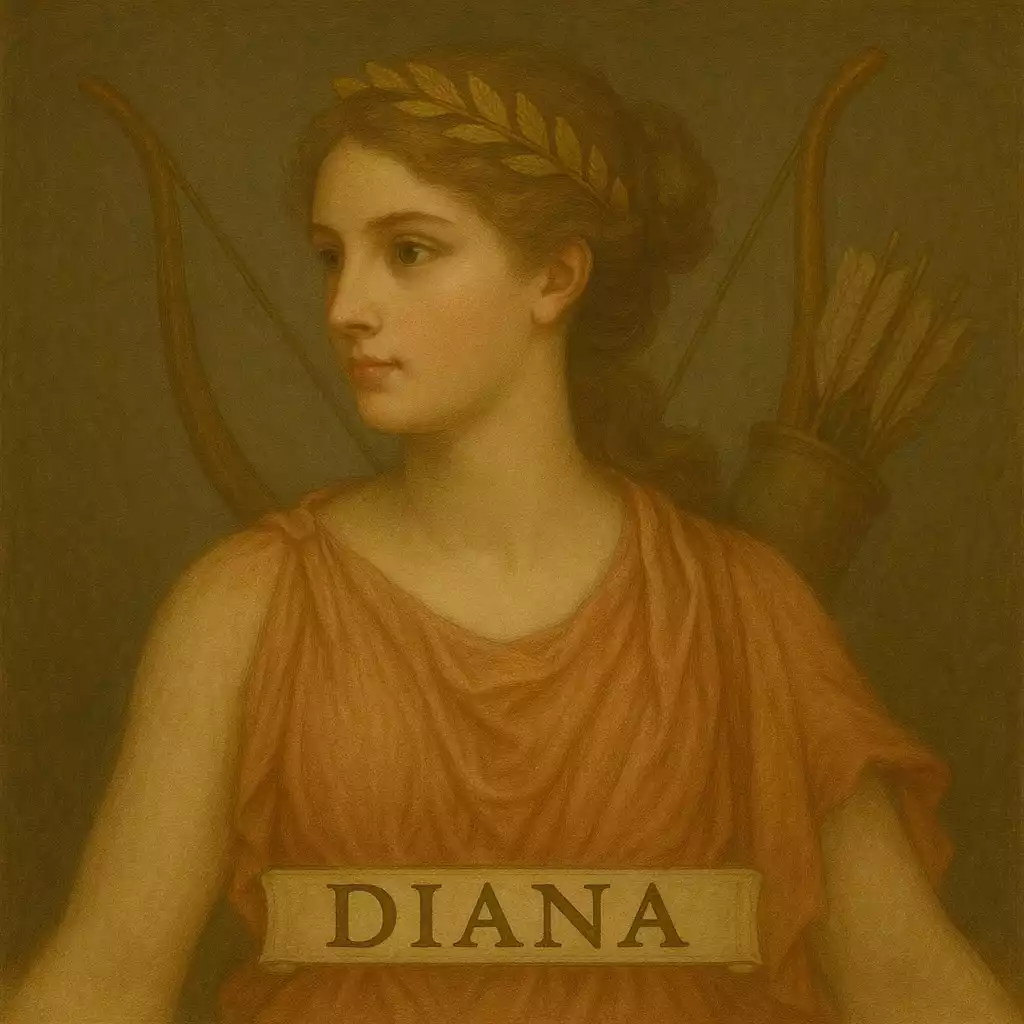
Diana: Moon Mother, Huntress, and the Wild Heart of the Goddess
There are goddesses whose names echo quietly through history, and then there are those whose presence refuses to fade — whose footsteps can still be heard in the rustling of trees, whose light still touches the surface of every moonlit pool, whose breath still moves in the night wind.
Diana is one such goddess.
To speak her name is to call forward a lineage of women who walked between worlds — priestesses, wanderers, healers, midwives, witches, daughters of the moon. She belongs to no one and yet to all, a goddess who moves unhindered through forest and sky, refusing to bow her head to any authority but her own. For a coven dedicated to the Goddess, Diana is not only an ancient deity — she is a living current of power, freedom, and feminine sovereignty.
This is not just a recounting of history.
This is a remembrance.
The Wild Goddess at the Edge of Civilization
Long before temples of marble were raised to her name, Goddess Diana lived in the quiet places — in the shadowed valleys, the cool groves where light filters like silver dust, the mountain heights where humans rarely dare to climb. She is one of the oldest faces of the Goddess in the Mediterranean world: a spirit of wilderness, moonlight, protection, and untamed womanhood.
In her earliest Italian sanctuaries, she stood apart from the political gods of Rome. Her worship was not dictated by emperors or senators; it was born from the land and held by those who lived close to it. Women who labored, slaves who fled, travelers who sought refuge — these were her children. Diana’s sacred groves offered what the world often refused:
- Safety.
- Freedom.
- Belonging.
Even now, when we gather in circle, it is her presence many of us feel first: that silent, watchful awareness that wraps around us like a cloak of night. Diana has always protected those who walk in their truth.
Diana of the Moon: Keeper of Cycles, Keeper of Women
To understand Diana is to remember that the moon was once seen as the great heartbeat of the earth — a luminous reminder that all things move in cycles. Waxing, waning, renewing, retreating. Nature does not apologize for its rhythm, and Diana calls us to remember we need not apologize for ours.
Her light is not the harsh blaze of the sun; it is the glow that reveals what can only be seen in shadows:
- intuition
- inner knowing
- the emotions we bury
- the power we forget we possess
For ancient women, Diana was the guardian of their physical and spiritual thresholds: puberty, sexuality, childbirth, aging, and death. She witnessed all phases and shamed none. Under her moon, no woman is too loud, too quiet, too fierce, too soft, too wild, too complicated. Diana knows the spectrum of womanhood because she embodies it.
We often call her the Lunar Huntress, but she is also:
- the midwife
- the guide of souls
- the watcher of crossroads
- the queen of the night
And she has never asked us to be anything but who we are — fully, unapologetically, fiercely.
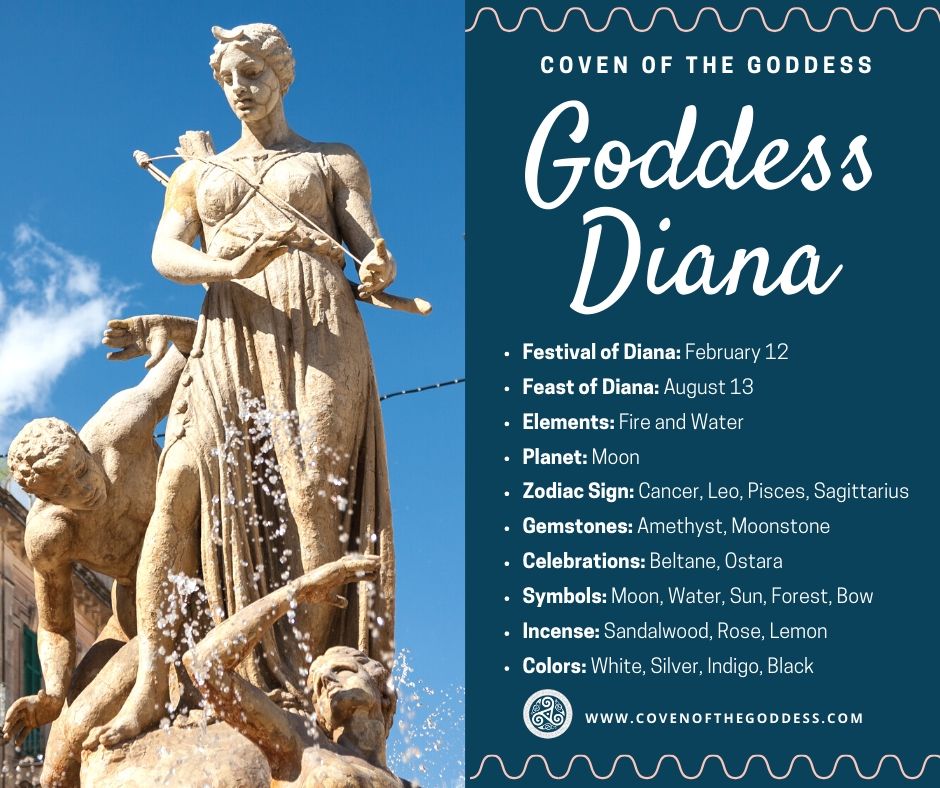
The Huntress: Power, Precision, Purpose
When Diana raises her bow, she teaches us something vital:
what you aim for becomes what you claim.
Her arrows are intention made manifest.
She does not fire without clarity.
She does not chase what does not serve her.
In a world that tells women to shrink, Diana expands.
In a culture that urges silence, Diana urges the call of the wild.
In a society that demands obedience, Diana keeps her own counsel and walks her own path.
As coven sisters, when we invoke her, we are invoking:
- the courage to pursue our truth
- the strength to defend what matters
- the instinct to recognize danger
- the wisdom to choose our path with purpose
The hunt, in her name, is never about destruction.
It is about focus, self-possession, and the ability to walk forward without fear.
Diana and the Sacred Feminine in All Its Forms
Throughout ancient Italy, Greece, and Asia Minor, Diana was known by many names — each one revealing a piece of her essence. Some traditions honored her as a tender mother, others as a cosmic protectress, others as a source of fertility for the land and all creatures.
Her roles were fluid because the feminine itself is fluid. Diana teaches that a woman is not one thing — not a single story, not a single identity, not a single expression. She can be:
- wild and disciplined
- nurturing and fierce
- solitary and communal
- earthly and celestial
Diana allows women to exist beyond limitation — and that truth made her dangerous to the patriarchal systems that later rose to dominate religion.
A Goddess Who Survived the Shifting of Worlds
As Christianity expanded across Europe, the divine feminine faced erasure, suppression, and re-interpretation. Yet Diana endured. She lived on in whispered stories, in folk practices, in moonlit rituals held in secret. Her name appears throughout late antiquity as a goddess still fiercely beloved, a deity whose temples and traditions would not fade easily.
In rural communities she remained:
- the protector of women
- the spirit of the night sky
- the guardian of animals
- the queen of witches, wise women, and healers
Where official religion sought to silence her, the people carried her in memory. Diana’s survival is a testament to the resilience of the Goddess: you cannot erase what is woven into the land, into the body, into the moon itself.
Diana and the Witch’s Path
Over centuries, especially in Italian folk magic, Diana became intertwined with the lineage of witches — not in the distorted sense crafted by fear, but in the ancient sense of women who held knowledge:
- herbalists
- midwives
- seers
- spirit-workers
- women who honored the cycles of nature
To these practitioners, Diana was not distant. She was the luminous guide who taught that magic is not forbidden — it is inherited. The wild is not chaotic — it is sacred. The night is not fearful — it is full of possibility.
For modern covens, Diana represents:
- empowerment without cruelty
- knowledge without shame
- magic without apology
- womanhood without limitation
She stands as a reminder that the Goddess was never meant to be hidden away — She was meant to be embodied.
The Call of Diana in Our Time
When we gather in circle today, we are not reviving a forgotten goddess.
We are answering a call that has echoed for thousands of years.
- Diana speaks to the parts of us that refuse to be domesticated:
- the girl who climbed trees and felt more at home outside than indoors
- the woman who feels the moon pull at her bones
- the healer who senses life in every leaf and stone
- the witch who knows that magic resides in instinct
- the sister who carries strength quietly until the moment it is needed
She reminds us that we were never meant to live small.
The world does not benefit from silenced women — it thrives when women rise, gather, and reclaim what has always belonged to them.
A Prayer for the Coven of the Goddess
Diana, Lunar Mother,
You who walk through the forests without fear,
You whose light awakens intuition,
You who guard every woman crossing her own thresholds —
be with us now.
Let your moonlight cleanse us.
Let your wildness free us.
Let your arrows focus us.
Let your strength steady us.
Teach us to trust our instincts,
to move through this world with ownership of our bodies,
ownership of our choices,
ownership of our power.
Let every sister who stands beneath your moon remember:
She is not small. She is not weak. She is not alone.
May we walk with you in truth,
hunt with purpose,
live with passion,
and honor the sacred wild that lives within us.
So it is.
So it has always been.
Conclusion: Diana Within Us
Diana is the shimmer on the lake at night, the sharp inhale of the forest before dawn, the breath of a woman who stands firm in her truth. She is the eternal reminder that the feminine is not confined — it is vast, lunar, elemental, and sovereign.
For a Coven of the Goddess, Diana is both ancestor and ally, myth and mirror.
She does not simply belong to the past.
She walks with the women of today — with us — each time we gather in circle, each time we speak our truth, each time we choose our own path.
Great is the Goddess Diana,
and great is the goddess within every woman who dares to awaken her.
Last Updated on December 27, 2025 by Abigail Adams

Comments (6)
I had heard that Goddess Diana had no children, and she was a virgin and she was part of the triple Goddess. So can someone please tell me then, maybe I’m thinking of the wrong Diana
My opinion is goddesses and gods as is true with mortals light and darkness exist when threats are perceived. Enlightenment is always the panacea.
Beautiful. Long live the Goddess within us all X.
Before Diana was Artemis
Wow, so I guess that make Diana and Lucifer the top dog ha? No wonder Christianity try to make her the ultimate evil. Although, I would recommend you read the whole book of revelation within the bible. An interest fact you would find is that, Satan is actually the good guy and the Christian god Yahweh, is actually the bad guy, the bible just present a distorted idea of good and evil, and right and wrong. A more interesting fact is that the image of Satan here is actually in coalition with Ishtar. Basically, the whole story is Yahweh come to declare war on the world accusing people for been evil for not worshipping him as one and only true god and kill, kill, kill and then Satan raise up to lead men to fight against Yahweh’s army. So, the bible accuse Satan and her follower to be evil and the two army have a massive show down.
I would recommend you take a look at the Hindu goddess Devi mother of heaven and earth and the Chinese Dao Goddess Nuwa, also the mother of heaven and earth, they are basically both spin off of Ishtar,
Well said