The Pentagram & the Pentacle: A Guide to Sacred Protection and Power
Meaning and History of the Pentagram and Pentacle
Long before modern spirituality had names and categories, people used symbols to express what words couldn’t hold: protection, harmony, belonging, the mystery of nature, and the longing to feel guided.
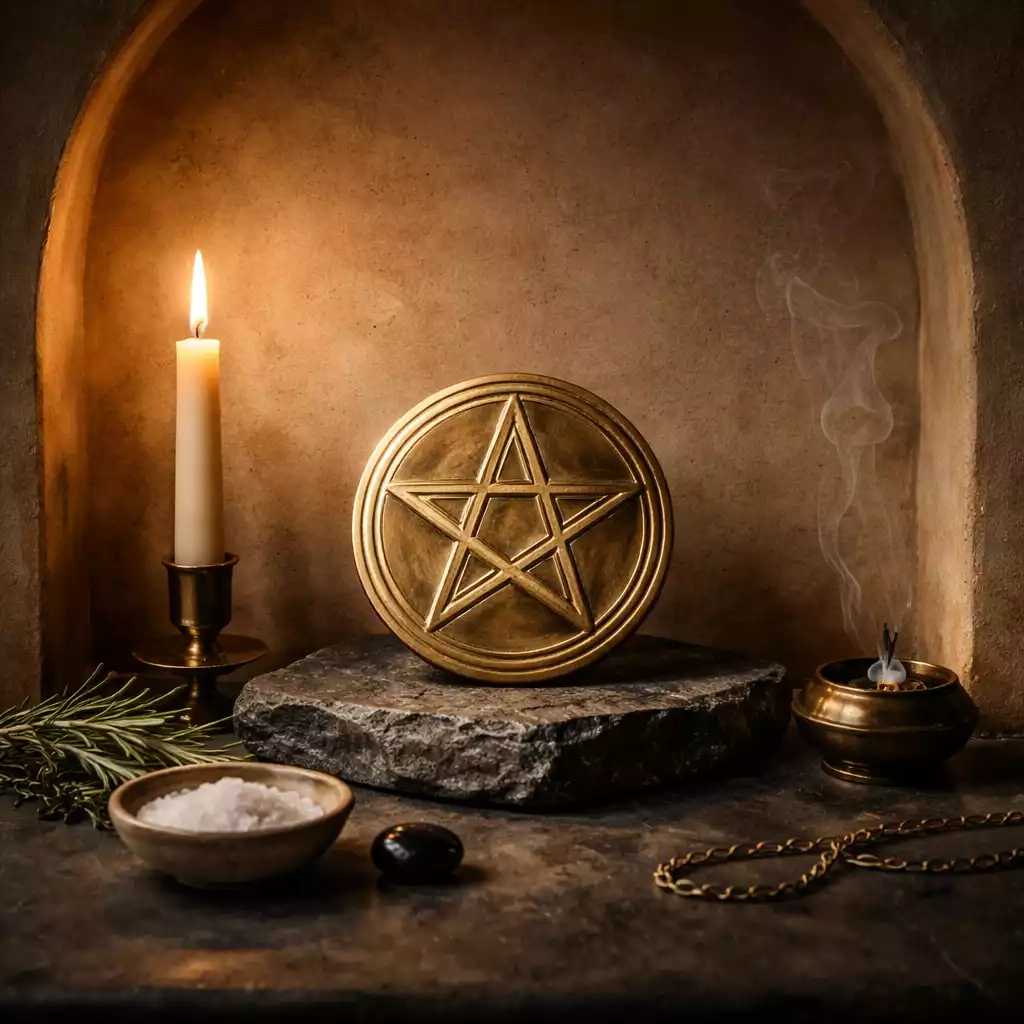
Two of the most recognizable symbols in modern witchcraft and Goddess-centered practice are the pentagram—the five-pointed star—and the pentacle, which is the pentagram held within a circle.
Across different cultures and time periods, variations of the five-pointed star have appeared in art, writing, and ritual contexts. Meanings have not always been identical, and traditions interpret the symbol differently—but again and again, the star is associated with order, balance, and the idea that life is made of forces that must work together.
In modern pagan and Wiccan traditions, the pentagram and pentacle are often used as symbols of protection, elemental harmony, and spiritual alignment—not fear.
They can also be deeply reassuring for beginners, because they offer something simple and steady: a shape you can return to when you want to feel centered, steady, and less reactive.
In this guide, you’ll learn:
- what the pentagram is, and what the pentacle is
- how they’re commonly understood in modern practice
- what the five points traditionally represent
- how to use these symbols respectfully in ritual and daily life
- a simple way to work with the pentacle for grounding and protection
If you’re brand new to witchcraft symbolism and ritual basics, start with Witchcraft Explained: Foundations of Magic to ground your practice in clear foundations.
The Pentagram — The Five-Pointed Star
The pentagram is a five-pointed star, traditionally drawn in one continuous line. That single, unbroken motion is one reason many practitioners experience it as a symbol of wholeness—a reminder that life isn’t meant to be lived in fragments.
In modern witchcraft and Wiccan contexts, the pentagram is commonly associated with:
- balance and integration (mind, body, spirit, and the elements working together)
- protection (especially when used with clear intention)
- awakening and self-development (the inner life becoming more conscious)
Rather than “controlling” anything, it’s often used as a centering symbol—a way to hold your attention steady when you’re calling in calm, clarity, or spiritual strength.
Want a deeper (still beginner-friendly) guide to working with the elements in practice—including directions and circle work? Continue with The Elements & The Watchtowers.
The Pentagram in Goddess-Centered Traditions
In Goddess-centered paths, the pentagram is often read through a lens of cycles, embodiment, and sacred nature. The number five can be linked—depending on tradition—to themes like the senses, phases of growth, the elements, and the directions used in ritual circles.
Some people also love the pentagram because it contains elegant geometry, and because it shows up visually in nature-inspired patterns. You don’t need to “prove” any single mystical origin story for it to be meaningful. What matters is how the symbol functions in practice: it helps many people feel grounded, protected, and aligned.
When you draw or wear a pentagram, you’re not automatically declaring a single belief system—you’re often choosing a symbol that reminds you to return to balance and inner authority.
The Pentacle — The Star Within the Circle
A pentacle is typically the pentagram enclosed within a circle. In many modern traditions, the circle is understood as a symbol of:
- unity and wholeness
- spiritual boundary and containment
- cycles and continuity
- the sacred space of ritual
If the pentagram represents the forces within you coming into harmony, the pentacle adds the idea of containment—energy held with intention, rather than scattered.
That’s why, for many, the pentacle feels especially supportive: it’s not just a symbol of power, but of protected power.
Why Beginners Often Feel Drawn to the Pentacle
Beginners often describe the pentacle as grounding and reassuring—not because it’s a shortcut or a guarantee, but because it creates a sense of structure.
It can act like a visual anchor: something you place on an altar, wear as a reminder, or focus on during a quiet moment to return to yourself.
Rather than “promising” protection, it supports a protective posture: clarity, boundaries, steadiness, and a calmer field—exactly the conditions where spiritual practice becomes cleaner and more effective.
The Five Points — The Five Elements of Magic
In many modern witchcraft and Wiccan traditions, the pentagram is often used as a teaching symbol for the five elements: Earth, Air, Fire, Water, and Spirit. Different paths place the points in different ways, so there’s no need to memorize a single “correct” map. What matters is the principle beneath the symbol: a balanced life—and a balanced practice—requires both the practical and the unseen, both the human and the sacred.
Below is one simple way to understand the five points as living energies you can recognize in your own life.
A Note on Placement
Different traditions place the elements on different points, but one widely used layout is:
- Top point: Spirit
- Upper left: Air
- Upper right: Water
- Lower left: Earth
- Lower right: Fire
If you’re following a specific path or teacher, use their placement—what matters most is learning what each element feels like and how to work with it in a balanced way.
Earth — The Body, The Foundation
Earth is stability. It’s the part of you that relaxes when life feels safe and supported. It’s the daily structure that holds your magic: sleep, nourishment, home, finances, routines, and boundaries. When Earth is strong, you feel grounded—not numb, not flat, but steady enough to trust yourself and build something real.
Air — The Mind, Clarity, and Communication
Air is thought, language, perspective, and perception. It’s how you name what’s true—and how you make meaning from experience. Air is the moment you stop spiraling and suddenly see the situation clearly. In practice, Air is strengthened through honest communication, learning, journaling, breathwork, and the willingness to let new insight replace old assumptions.
Fire — Will, Courage, and Transformation
Fire is the force that moves you from knowing to doing. It’s desire, courage, confidence, and the will to change what needs to change. Fire isn’t only passion—it’s also self-respect, momentum, and the part of you that refuses to stay stuck. When Fire is healthy, you act with clean conviction instead of impulsiveness, and your choices begin to reshape your life.
Water — Emotion, Intuition, and Healing
Water is sensitivity, empathy, love, grief, longing, and the depth that makes life meaningful. It’s also the intuitive current—what you know without needing proof. In magical practice, Water relates to emotional release, dream language, and the ability to feel truth in the body. When Water flows cleanly, you become emotionally honest without being emotionally ruled.
Spirit — The Sacred Thread
Spirit is the element that isn’t quite an element. It’s the connecting thread—the part of you that seeks meaning, remembers the sacred, and longs to live in alignment. In Goddess-centered paths, Spirit may be experienced as the presence of the Divine Feminine, higher self, inner knowing, or holy intelligence moving through life. When Spirit is awake, your practice stops being “technique” and becomes relationship—with yourself, with the Goddess, and with what you choose to serve.
The Upright vs. Inverted Pentagram
Beginners often ask, “Is an upside-down pentagram bad?”
The honest answer is: it depends on context, tradition, and intent—and it’s worth understanding that before you let internet fear teach you your symbols.
The Upright Pentagram
In many modern pagan and Wiccan-inspired practices, the upright pentagram is used as a symbol of balance and spiritual alignment—often interpreted as Spirit guiding the elements (or Spirit guiding “matter”). It’s widely recognized in contemporary witchcraft spaces as a symbol of protection, harmony, and steady growth.
If you’re new to the path, the upright pentagram is usually the most comfortable place to begin because it’s commonly taught as the “default” in beginner materials and ritual work.
The Inverted Pentagram
The inverted pentagram has multiple meanings across history and modern practice, and it’s not automatically “evil” on its own. In some traditions, it can be used to explore shadow work, deeper initiatory symbolism, or the process of bringing spiritual truth into the lived, physical world. In other contexts—especially pop culture or certain modern groups—it has been used in more provocative or adversarial ways.
So instead of treating the inverted pentagram as “good” or “bad,” it’s more accurate to treat it as a symbol with different uses depending on who is using it and why.
Beginner Guidance
If you’re just starting, choose the upright pentagram or pentacle until you feel grounded in your practice and confident in your symbolism. A symbol becomes powerful when you understand it—not when you fear it.
The Pentacle as a Tool of Protection
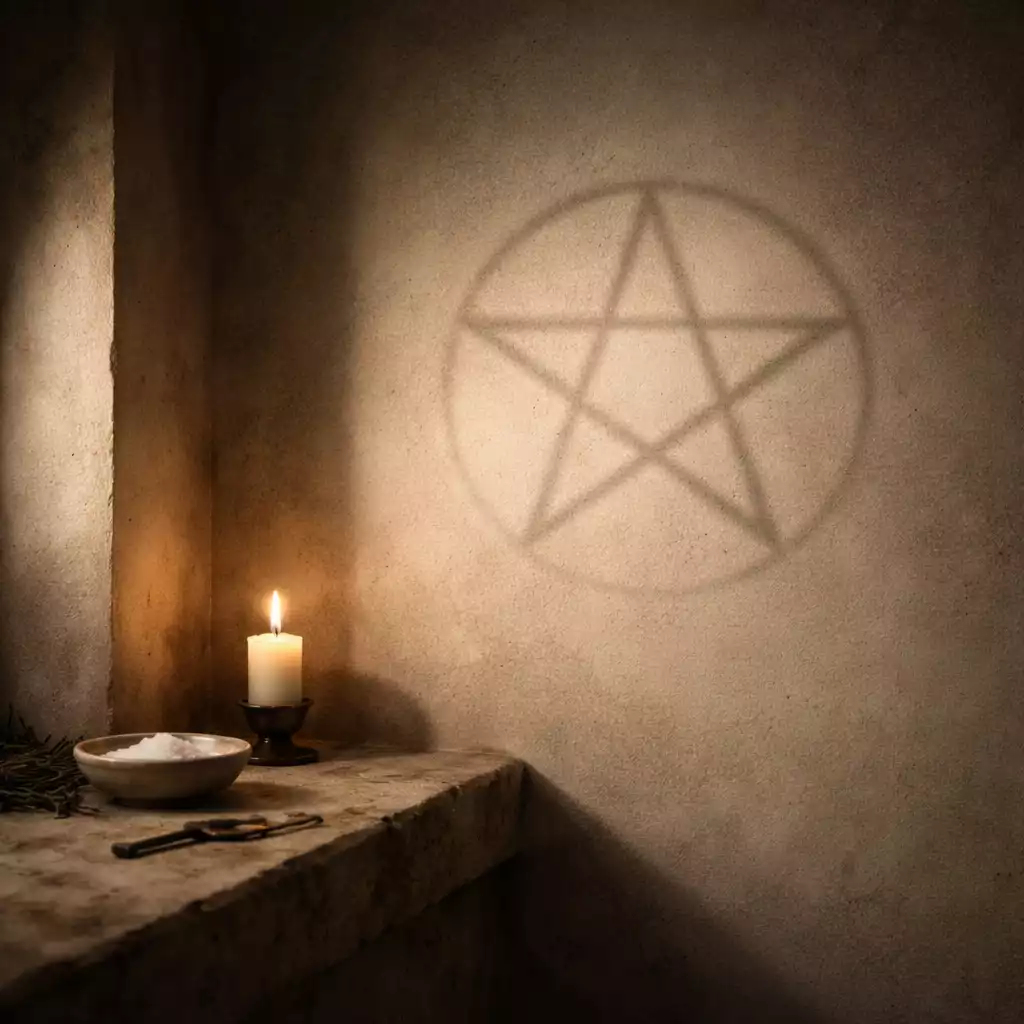
The pentacle has been used for protection in many folk, pagan, and magical traditions because it carries a simple spiritual logic: when your inner world is balanced, your energy is harder to disturb.
Protection is not fear. It’s awareness. It’s love with boundaries. It’s the choice to stay anchored in your own center instead of letting outside noise, pressure, or emotional weather pull you off your path.
In practice, the pentacle is often treated as a symbol of elemental harmony—a reminder to stay grounded (Earth), clear (Air), courageous (Fire), emotionally true (Water), and spiritually aligned (Spirit). When those parts of you are in conversation, your field feels more stable. Your intuition becomes sharper. Your boundaries get cleaner. That’s what “protection” looks like in real life: steadiness, clarity, and the ability to return to yourself quickly.
When worn, drawn, or placed intentionally, a pentacle can function like a gentle guardian—not because it “fights” the world, but because it helps you hold your own energy with more coherence.
Ways to Use a Pentacle for Protection
- Wear it as a necklace or keep it close on your person
- Place one on your altar as a grounding centerpiece
- Trace it in the air before ritual to seal your space
- Place it near a doorway as a symbol of spiritual boundaries
- Keep one under your pillow to support calmer sleep
- Use it as a base to charge crystals, herbs, or written intentions
The key is intention: the pentacle responds best when you use it as a living symbol—a reminder to return to balance, rather than a charm you rely on instead of your own inner authority.
The Pentagram in Ritual and Magic
You don’t need to be an experienced witch to work with the pentagram. You need sincerity, respect, and a clear reason for using it. In ritual, the pentagram is often used as a gesture of focus—a way to cleanse a space, seal intention, and bring your energy into order before you begin.
1) Drawing the Pentagram
You can draw a pentagram in a simple, quiet way—no elaborate tools required. Some people trace it with a finger, others use a wand, incense smoke, or a light-visualization. What matters is that you draw it slowly and deliberately, as if you are shaping clarity into the air.
An easy method for cleansing is:
Start at the top point, move down to the lower left, and continue in one continuous line until the star closes.
As you draw it, speak a short line that matches your intent, for example:
“I purify this space in the light of the Goddess.”
(If “Goddess” isn’t your language, substitute “the Divine,” “Spirit,” or “sacred protection.”)
2) Invoking and Banishing Pentagrams
Different traditions use different pentagram “forms” to either invite energy in or clear energy out. If you’re new, you don’t need to memorize complex systems. You can work with the principle in a grounded way:
- Invoking = calling in blessings, support, clarity, protection
- Banishing = releasing heaviness, clearing tension, cleansing the space
When in doubt, keep it simple: use an upright pentagram, pair it with a calm intention, and focus on cleansing and protection rather than anything forceful.
3) Using a Pentacle on Your Altar
A pentacle (the pentagram within the circle) is often used on an altar as a container—a place where energy gathers and holds steady. It can help your space feel more grounded, protected, and intentionally “set.”
You can place items on the pentacle to charge them with focused purpose, such as a candle, a crystal, herbs, a small offering, or a written intention. Think of it less as “powering up objects” and more as creating one clear center where your ritual energy can land and stay coherent.
How to Use a Pentacle in Daily Life
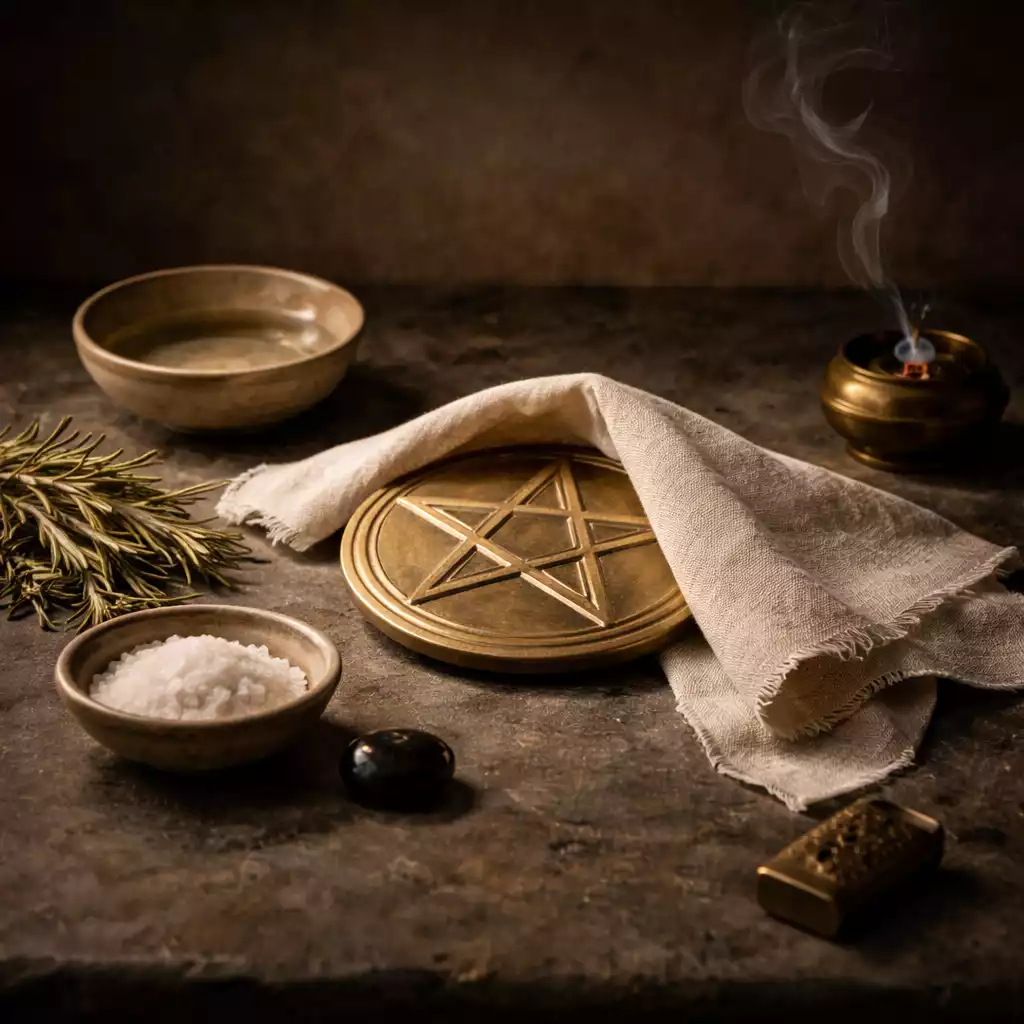
The pentacle isn’t only a ritual tool. It’s also a daily anchor—a small, steady reminder that you can return to balance on purpose, not only when life forces you to.
If you wear a pentacle, keep one on your altar, or carry one in a pocket, you can use it like a “reset point” in ordinary moments:
- For emotional balance: rest your hand over the pentacle and take a few slow breaths, letting Water soften the heart and calm reactivity.
- For mental clarity: bring attention to the Air point and imagine it brightening—like a window opening in the mind—so confusion can loosen.
- For courage: touch or tap the Fire point and let it remind you of clean will: the ability to act without panic.
- For grounding: focus on Earth and picture roots—simple stability, practical presence, the body feeling safe.
- For spiritual connection: touch Spirit at the top point and whisper a short intention, a prayer, or a request for guidance.
Over time, this becomes less “symbolic” and more practical: a consistent way to re-center your energy before you speak, choose, rest, or begin again.
Why the Pentagram Feels So Familiar
Many beginners say, “I don’t know why I’m drawn to it—it just feels right.” That’s common, and it makes sense.
The five-pointed star shows up naturally in the world: in patterns of growth, proportion, and symmetry that humans have noticed for centuries. When you look at the pentagram, something in you recognizes order—a kind of balanced architecture that feels both ancient and personal.
So for many people, it doesn’t feel like learning a new symbol. It feels like remembering a language you already understand.
The Pentagram and the Goddess
In Goddess-centered practice, the pentagram can also be approached as a living map of the Feminine—not as one narrow role, but as a complete spectrum of power.
A common way to experience the points is through the Goddess as:
- Earth — the Mother (stability, nourishment, home)
- Air — the Maiden (clarity, curiosity, beginnings)
- Fire — the Warrior (courage, will, transformation)
- Water — the Lover (emotion, intuition, devotion)
- Spirit — the Crone / the Infinite (wisdom, mystery, sacred sight)
You don’t have to force this interpretation. If it resonates, let it deepen your relationship with the symbol. If it doesn’t, you can still work with the pentagram as what it always is at its core: balance held with intention.
Simple Pentacle Ritual for Protection and Grounding
This is a gentle, easy ritual you can do anytime you want to feel more centered, protected, and clear. You don’t need tools—only a few quiet minutes and sincere intention.
1) Settle and arrive
Sit comfortably. Let your shoulders drop. Feel your feet (or the weight of your body) supported. Take three slow breaths and let your attention return to the present moment.
2) Create the symbol in your inner sight
Close your eyes and imagine a pentacle in front of you: a five-pointed star held inside a circle. Let it appear in silver, gold, or soft moonlight—whatever feels natural.
3) Touch the five points, one by one
Move through the points slowly. You can imagine touching them with a fingertip of light, or simply bringing your attention to each one.
- Earth: “I am grounded.”
- Air: “I am clear.”
- Fire: “I am strong.”
- Water: “I am intuitive.”
- Spirit: “I am whole.”
Pause for a breath after each line. Let it land in your body.
4) Seal it with the circle
Now imagine the circle around the star becoming brighter and steadier—like a calm boundary. Not a wall, but a clean container: protection, focus, and balance.
5) Speak the closing blessing
Whisper (or say silently):
“By the five-fold star,
I rise in my power.
I walk in balance.
I am protected.
I am guided.
I am sacred.”
6) Return gently
Take one last slow breath. Open your eyes. Notice how your body feels—quieter, steadier, more present.
You can do this daily, or anytime you feel scattered, emotionally flooded, or about to begin a ritual or spell.
Closing: You Are the Star
The pentagram and the pentacle are not “outside” symbols you have to earn. They’re mirrors—showing you what is already true about you: a life made of body and breath, desire and feeling, intuition and spirit, all meant to work together.
When you honor the star, you honor your own balance.
When you trace it, you return to clarity.
When you wear it, you remember your boundaries—strong, calm, and sacred.
You are made of Earth, Air, Fire, Water, and Spirit.
You are not missing what you seek—you are learning how to hold it.
You are a walking pentacle: a living harmony of the seen and unseen.
A moving temple. A quiet altar. A sacred presence in human form.
And if the symbol feels familiar, it’s because it speaks a language older than your mind.
You are the star—
and now you remember.
Last Updated on January 23, 2026 by Abigail Adams


Leave a Reply