
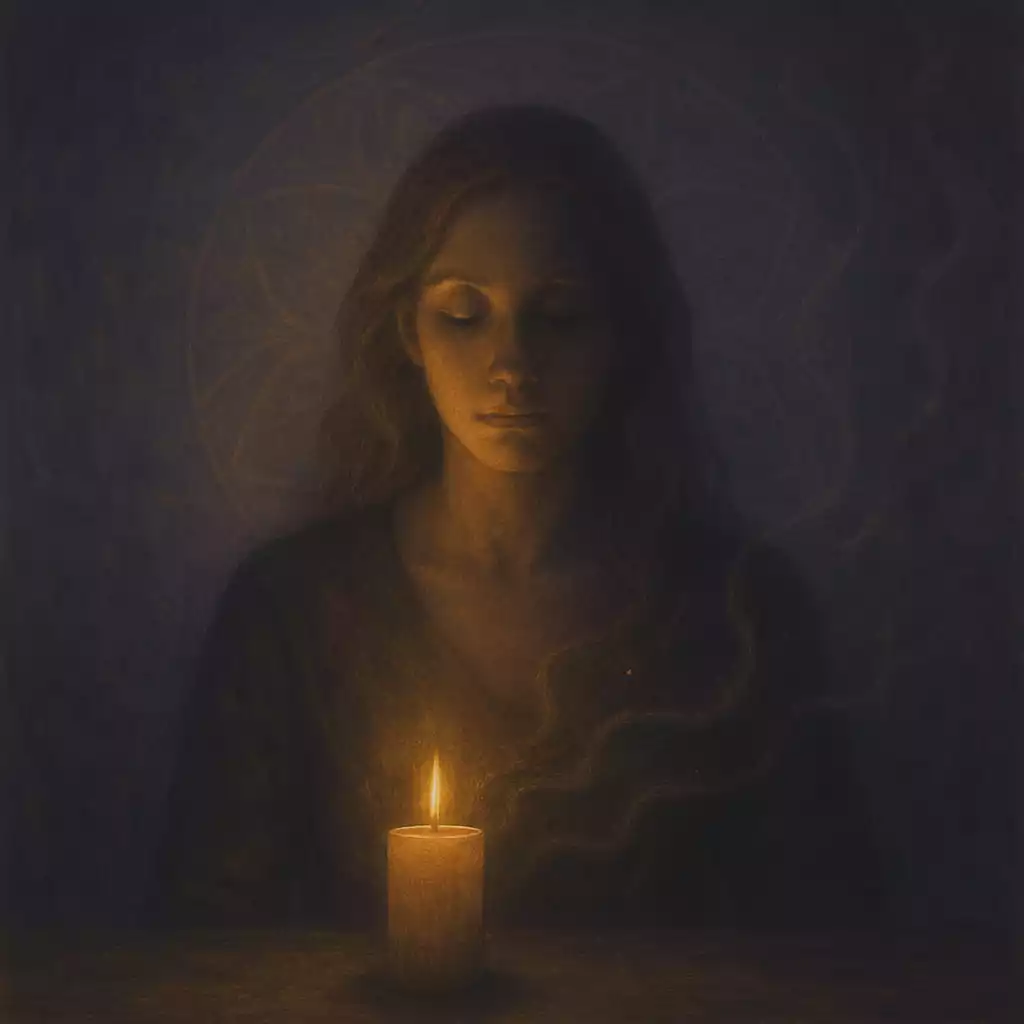
Shadow Work & Emotional Alchemy — The Heart of What People Call “Dark” Magic
Table of Contents
Introduction — Why Shadow Work Feels Like “Dark Magic” to Outsiders
Shadow work is one of the most misunderstood aspects of the spiritual path. To those on the outside, its language can sound mysterious — even threatening. Words like shadow, inner darkness, or emotional excavation often stir the same fears that once fueled myths about “black magic.” But the truth is far simpler, far softer, and far more human: shadow work is the practice of meeting the parts of yourself that have been waiting to be seen.
There is nothing sinister about acknowledging emotion.
There is nothing dangerous about understanding your own depth.
There is nothing dark about healing.
Yet society has long been conditioned to avoid discomfort, suppress intensity, and fear the unknown terrain of the inner world. When someone begins to explore their shadow — their unmet needs, their anger, their longing, their grief, their desire, their boundaries — it can look to outsiders like a departure from the familiar path of “light.” But shadow work is not a rejection of light; it is what makes light real.
This work asks for honesty, courage, and a willingness to sit with what is usually hidden beneath the surface. It is the art of turning inward without flinching, of letting truth replace avoidance. And because it deals with layers of the psyche that most people never touch, it has often been mislabeled as something dark or spiritually risky.
In reality, shadow work is not a descent into darkness — it is a return to wholeness. A process of reclaiming every part of yourself so you can move through the world with deeper strength, clearer intuition, and authentic sovereignty.
Shadow work is often misunderstood and labeled as “dark,” much like the broader misconceptions explored in our Black Magic — Truth, Myth & Modern Meaning guide.
The Psychological Roots of Shadow Work
Shadow work is not a mystical invention — it is a psychological truth woven into the structure of every human life. Long before witchcraft adopted the language of the shadow, psychologists, healers, philosophers, and storytellers all recognized the same reality: we carry parts of ourselves that we learn to hide. Not because they are wrong, but because we were taught they were too much.
From childhood onward, we absorb messages about which emotions are acceptable and which are inconvenient. Anger becomes unsafe. Vulnerability becomes shameful. Sensitivity is dismissed. Desire is judged. Strength is feared. Over time, these unvalidated emotions sink beneath the surface and form what psychologists call the unconscious — the storage place of everything we have not yet learned to hold.
Shadow work enters here.
It is the bridge between psychology and spirituality.
Rather than denying the unconscious, the practitioner turns toward it with curiosity. In this sense, the shadow is not darkness; it is unprocessed experience. A memory that still aches. A boundary that was never defended. A truth that was swallowed to keep the peace. An emotion that never had space to breathe.
When these pieces remain unseen, they influence our relationships, our self-worth, our choices, and even our magic. But when brought into awareness, they lose their power to sabotage. They become sources of insight, wisdom, and inner strength.
This is why witches embrace shadow work: it creates integrity. A witch who knows their inner landscape cannot be manipulated by unexamined fear or old stories. Their magic is clearer. Their intuition is stronger. Their decisions, boundaries, and rituals come from a place of conscious choice rather than reaction.
Shadow work does not create darkness — it reveals truth.
In psychology, this is healing.
In witchcraft, this is power.
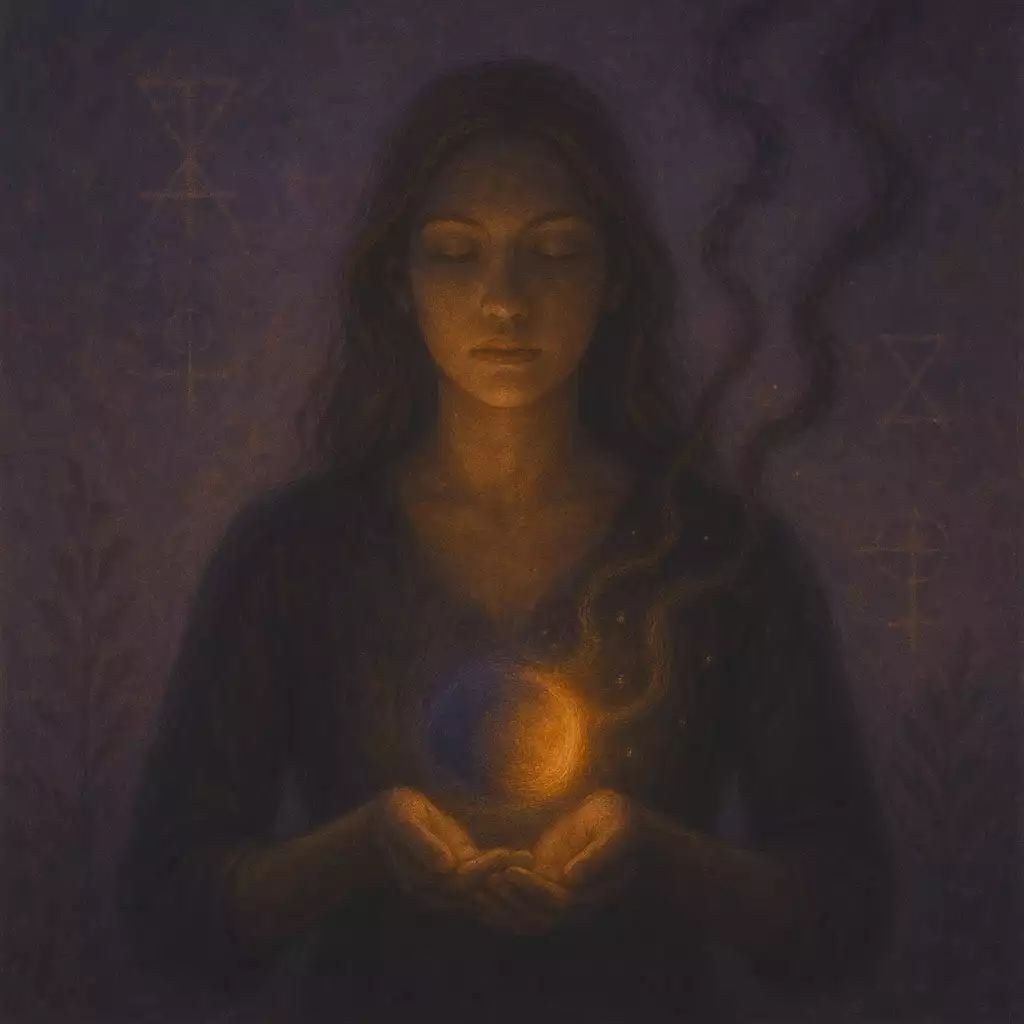
Emotional Alchemy — Transforming What We Fear
Emotional alchemy is the heart of shadow work. It is the process through which we take an emotion we have feared, avoided, or misunderstood and allow it to shift into something more useful, more truthful, and more empowering. In ancient traditions, alchemy was about turning base metals into gold. In modern spiritual work, emotional alchemy is the transformation of unprocessed feeling into clarity, strength, and self-understanding.
Most people are taught to fear intense emotions. Grief is seen as weakness, anger as danger, desire as something shameful, and fear as something to hide. Because of this conditioning, strong feelings become exiled to the unconscious, where they intensify and distort. They do not disappear — they simply lose the benefit of conscious guidance.
Emotional alchemy begins by reversing this pattern.
Instead of avoiding emotion, the practitioner meets it directly — not to indulge it, but to understand it. What feels overwhelming becomes manageable when witnessed with neutrality. What once seemed threatening becomes information. And what once held power over us becomes a source of inner authority.
For witches, this process deeply enhances magical work. Emotion is energy, and energy fuels intention. When emotion is unregulated, magic becomes scattered. When emotion is understood, magic becomes precise. Alchemy turns reactive energy into creative force — a powerful shift that separates chaotic spellcasting from conscious, ethical practice.
To practice emotional alchemy is to say:
“I am not afraid of my own depth.”
It is choosing to sit with discomfort long enough to uncover the message beneath it. Anger may reveal a violated boundary. Grief may reveal love. Fear may reveal unmet needs. Desire may reveal authentic direction.
When emotion transforms, so does the self.
This is the gold that shadow work creates — not darkness, but mastery.
The Mislabeling of Shadow Work as “Dark” or “Negative”
For centuries, anything connected to emotional depth, personal truth, or feminine intuition has been misunderstood. Shadow work is no exception. Because it involves acknowledging emotions that society teaches us to suppress — anger, grief, desire, fear, longing — many assume it must be dangerous or “dark.” But this misunderstanding says far more about cultural discomfort with emotion than about the work itself.
Shadow work becomes mislabeled as negative for one simple reason: it asks us to look directly at what others pretend does not exist. In a world built on appearances, politeness, and emotional restraint, authenticity can look rebellious. Boundaries can look threatening. Honesty can look disruptive. And self-awareness can look like power — which it is.
Historically, anything that empowered individuals to think, feel, or heal outside approved systems was associated with darkness. Emotional intelligence was not considered spiritual. Women who spoke their truth were dismissed as dramatic or unstable. Communities treated grief and anger as failures of self-control rather than natural human responses. Within that mindset, shadow work — the act of meeting your own emotional landscape — became associated with danger simply because it defied the cultural script.
But shadow work is not negativity.
It is neutrality.
It is presence.
It is truth.
There is nothing inherently dark about acknowledging your own pain. There is nothing harmful about discovering where a boundary needs to be set. There is nothing negative about healing a wound that has quietly shaped your choices for years.
If anything, the refusal to do shadow work creates more harm than the work itself ever could. Suppressed emotions leak into relationships, self-worth, health, and magic. Unseen patterns repeat. Unexpressed truth erupts.
Shadow work interrupts these cycles. It turns unconscious patterns into conscious power. What once looked frightening from the outside becomes liberating from within — not darkness, but illumination.
Many of these misunderstandings come from the historical and cultural distortions addressed in our main article on the truth behind black magic.
Shadow Work Practices in Modern Witchcraft
Shadow work is not a single technique. It is a relationship — a long, steady conversation between the seen and unseen parts of yourself. In modern witchcraft, this work unfolds through simple, intentional practices designed to create space for truth. These practices are not dramatic or performative; they are intimate, clarifying, and deeply human.
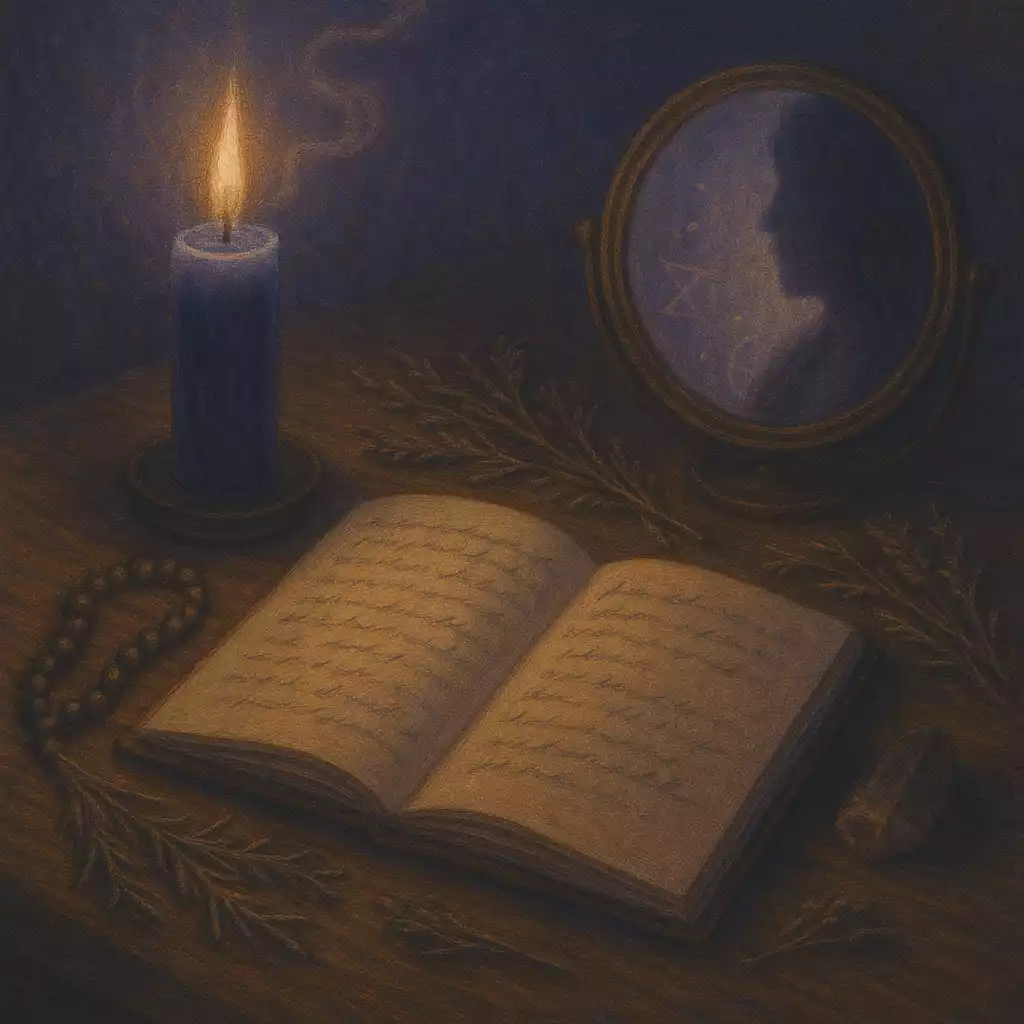
One of the most accessible forms of shadow work is journaling. Not the tidy, curated kind, but the version where honesty comes before aesthetics. Writing lets emotion move from the body into language. Thoughts become visible. Patterns that once felt tangled begin to separate and reveal shape. For many witches, journaling is the first doorway into inner alchemy because it transforms chaos into clarity.
Candle work is another foundational practice. A single flame becomes a focal point for exploration — steady, neutral, and quietly revealing. Sitting with a candle allows the mind to soften, making it easier to name emotions without judgment. Black, purple, or deep blue candles are often chosen not for darkness, but for depth. They hold space for what rises without overwhelming the senses.
Mirror work takes this further. It is the practice of meeting your own gaze without filtering or performing. Many people go their entire lives without truly looking at themselves. Mirror work interrupts that distance. It helps you recognize the parts of yourself that have waited patiently for acknowledgement — strength, sorrow, resilience, anger, tenderness. All of them belong.
Some practitioners incorporate ancestral awareness, sensing how inherited stories and family patterns shape their emotional landscape. Others explore cord awareness, identifying where emotional ties have become draining or imbalanced, not to sever relationships, but to reclaim energy and autonomy.
These practices are not about summoning darkness. They are about seeing clearly. When approached with intention, they reveal the layers of the self that make magic real, grounded, and powerful. Shadow work is not the opposite of light — it is the structure that allows the light to mean something.
Ritual: The Inner Lantern Ritual (20 Minutes)
Shadow work does not require complexity. It requires presence. The Inner Lantern Ritual is a gentle, twenty-minute practice designed to help you illuminate your inner landscape with compassion rather than fear. Its purpose is not to confront darkness, but to reveal what has been waiting quietly beneath the surface.
Choose a comfortable space where you can sit undisturbed. Dim the lights or allow the natural softness of evening to guide the atmosphere. Place a single candle before you — white, gold, or deep indigo. This candle represents your inner lantern, the steady part of you that remains present no matter what emotion arises.
Begin by taking slow breaths, letting your body settle. When you feel anchored, light the candle. Watch how the flame moves: steady, flickering, alive. This flame is not here to expose you. It is here to accompany you.
Close your eyes for a moment and ask yourself: What part of me needs light tonight? It may be a feeling, a memory, a question, or a sensation with no clear name. Whatever appears, allow it to exist without trying to fix or judge it.
Open your eyes and let the candle illuminate this inner truth. Visualize the flame shining gently upon it, not to dissolve it, but to make it visible. Notice how the emotion shifts when seen rather than suppressed. Stay with it as long as feels natural.
When you’re ready, place your hand over your heart and whisper: “I see you. I honor you. I carry you forward with wisdom.”
Extinguish the candle with gratitude. The ritual ends quietly — not with transformation forced, but with truth acknowledged.
This is how inner strength grows: softly, steadily, from the light you make within.
Invocation for Courage & Inner Illumination
Light within me, rise and reveal.
Shadow within me, soften and speak.
What I once feared, I now witness.
What I once hid, I now hold with grace.
May courage open every locked door,
May clarity walk with me in every breath,
May truth become my lantern
And wisdom become my guide.
I welcome all parts of myself—
The tender, the fierce, the quiet, the deep.
I am whole, I am present, I am unafraid.
What was hidden now becomes light.
What was fragmented now becomes power.
So it is.

Conclusion — The Shadow as a Pathway to Power
Shadow work is not a descent into darkness; it is a return to inner truth. It asks you to meet yourself without filters, without performance, and without shame. It is the art of seeing clearly — and clarity is one of the greatest powers a witch can cultivate.
When you understand your shadow, you become less influenced by fear, doubt, or old emotional patterns. Your intuition sharpens. Your boundaries strengthen. Your magic becomes rooted not in reaction, but in intention. What once felt overwhelming begins to feel like information. What once felt threatening becomes a map. And what once controlled you from the unconscious becomes a resource you can draw from consciously.
This is why shadow work is so often misunderstood. It is powerful, and power has always made the world uncomfortable. But it is not destructive power — it is restorative power. A reclamation of the pieces that make you whole.
When you walk this path with compassion and curiosity, the shadow ceases to be something to fear. It becomes a teacher. A guide. A truth-teller. A source of emotional depth and spiritual maturity.
To know your shadow is to know yourself.
And to know yourself is to step into magic with a level of sovereignty that cannot be shaken.
If you wish to explore how shadow work fits into the larger history and cultural evolution of so-called “dark” magic, read the full article:
👉 Black Magic — Truth, Myth & Modern Meaning




Leave a Reply